

Before to start what is cc in engine, Imagine you saved money for two years to buy a dream superbike, and After saving money for two years, you finally reached your goal of buying your dream superbike. Excited and proud, you decided to visit the showroom the next day.
When the day arrived, you walked into the showroom with great enthusiasm and said to the salesperson, “I want to see a superbike.”
The salesperson smiled and asked, “Sure, sir. What engine capacity (cc) are you looking for?”, You paused for a moment, confused, and replied, “What exactly is cc in engine?”
What does cc in cars and bikes
The cc in engine full form is cubic capacity, That means the volume present in the engine where the air and fuel mixture compress and burned to take a combustion process and it is measured in cubic centimeters. A unit measured for volume, like Kgs for weight and Kms for distance.
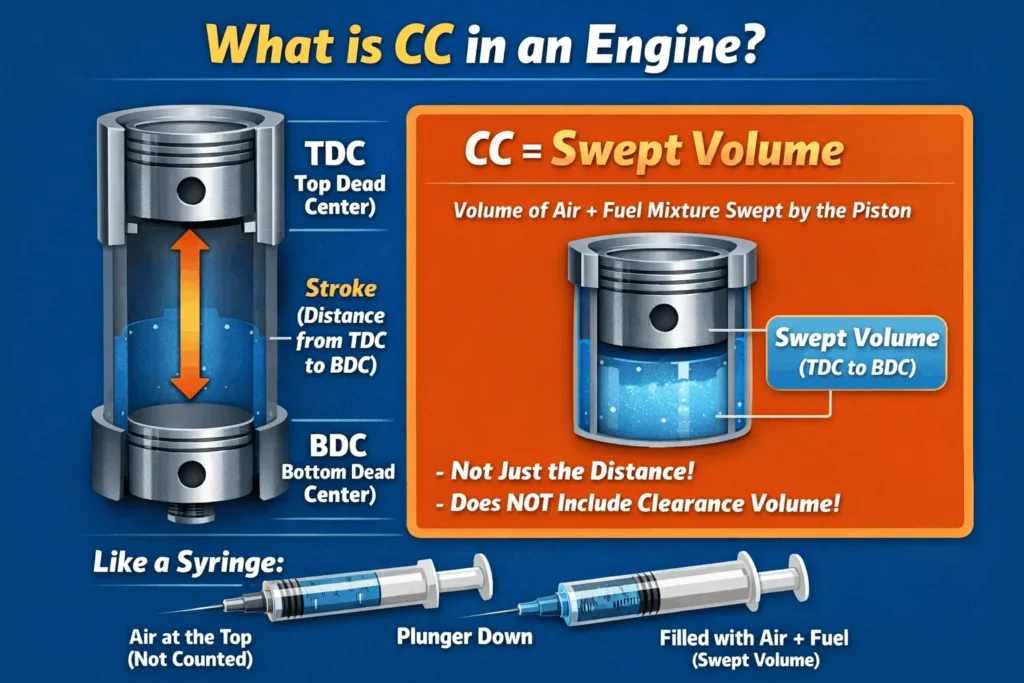
In technical words the cc means the the swept volume of the piston from Top Dead Center (TDC) to Bottom Dead Center (BDC)
This means:
- It includes only the space the piston moves through
- It does not include the small remaining space at the top (clearance volume)
so, Total Cylinder volume = Swept volume (cc) + Clearance volume
But, CC = Swept volume
- Swept volume (CC) = volume from TDC to BDC
- Clearance volume = small space left at TDC
How does CC is calculated
The formula for Cubic Capacity (cc) = Π/4 * (Diameter of cylinder)^2 * Stoke length * No of Cylinders
For Example
- For CC in bikes = (3.14/4) * 5^2 * 5*1= 98.125 cc ~ 100 cc
- Where
- Π = 3.14
- Diameter of cylinder = 50mm = 5cm
- Stroke Length = 50mm = 5cm
- No of cylinders = 1
- Where
- For CC in cars= (3.14/4) * 8^2 * 5*4 = 1005.3cc ~ 1000cc
- Where
- Π = 3.14
- Diameter of cylinder = 80mm = 8cm
- Stroke Length = 50mm = 5cm
- No of cylinders = 4
- Where
How CC in vehicles will effects the performance
The cc plays an important role in the vehicle performance like the speed, torque and power. These are directly effect the vehicle experience with the diver in terms of performance, fuel and the driving experience.
1. Power Output:
As we discussed earlier, the cc means the volume present in the engine where the air and fuel mixture compresses and burns to take a combustion process. If that volume is more, then the more air and fuel that enter into the cylinder will lead to a more impactful combustion process. If great combustion means more energy as an output. This leads to better top speed and acceleration.
- Higher CC → more fuel burned → more energy → higher power
- Example:
- 100cc bike → low power
- 1000cc superbike → very high power
- Result: Better top speed & acceleration
2. Torque
Generally, the larger cc in engines are produce more torque compared to smaller cc in engines because like same above the more powerful combustion leads to creates higher pressure inside the cylinder, which pushes the piston down with greater force. Torque is essentially the rotational force produced at the crankshaft. When the piston is pushed down harder due to higher pressure, it turns the crankshaft with more force, resulting in higher torque.
To know about Engine parts like piston, crankshaft or basics of engine
This high torque will the vehicle in different conditions like climbing the hills, carryings heavy loads and performing smooth overtaking without struggling etc.
- Bigger engines generate more torque
- Helps in:
- Carrying heavy loads
- Climbing hills
- Smooth overtaking
- Result: Stronger engine pulling capability
3. Acceleration
Engines with higher CC can generate more power and torque, allowing them to produce greater force in a shorter amount of time. This increased force helps the vehicle gain speed more quickly from a standstill. As a result, vehicles with higher CC typically achieve faster acceleration, leading to quicker 0–60 km/h times.
- More CC engines can push more force quickly
- Result: Faster 0–60 km/h times
4. Fuel Consumption
Higher CC in engines consume more fuel because they burn a larger amount of air–fuel mixture in each cycle. As a result, vehicles with lower CC engines generally offer better mileage, while higher CC engines tend to have lower fuel efficiency.
- Higher CC → burns more fuel burn leads to less mileage
- Lower CC → burns less fuel burn leads to more mileage
Types of engines based on cc
The engine are divided into three types based on the cubic capacity (cc) and their are:
- Low cc engines
- Medium cc engines
- High cc engines
1. Low cc engines
Low CC in engines have smaller engine volume. For bikes, this is usually up to around 150 cc, and for cars, up to about 1200 cc.
These engines are mainly designed for better mileage and daily commuting. They don’t produce very high power, but they are easy to maintain, fuel-efficient, and budget-friendly, which makes them perfect for city use.
Examples:
- In Bikes
- Hero Splendor Plus with 92.2cc
- Honda Activa with 109.51cc
- In Cars
- Maruti Alto 800 with 796 cc
- Renault Kwid with 999 cc
2. Medium cc engines
Medium CC in engines have a moderate engine volume. For bikes, this usually ranges from around 150 cc to 500 cc, and for cars, from about 1.2L (1200cc) to 2.0L(2000cc).0
These engines offer a good balance between power and mileage. They are suitable for both city rides and highway trips, giving better performance than low CC engines while still maintaining decent fuel efficiency.
Examples:
- In Bikes:
- Royal Enfield Classic 350 with 349 cc
- Bajaj Pulsar NS200 with 199 cc
- In Cars:
- Hyundai i20 –with 1.2L
- Maruti Suzuki Baleno – 1.2L
3. High cc engines
High CC engines have a large engine volume. For bikes, this is above 500 cc, and for cars, above 2.0L.
These engines are built for high power and performance. They provide strong acceleration, higher speed, and better torque, but they consume more fuel and have higher maintenance costs.
Examples:
- In Bikes:
- Kawasaki Ninja ZX-10R –with 998 cc
- Royal Enfield Interceptor 650 with 648 cc
- In Cars:
- Toyota Fortuner with 2.8L
- Ford Mustang GT with 5.0L V8
Why Bikes Use CC and Cars Use Liters
Both bikes (cc) and cars (liters) refer to the same concept: engine displacement, which is the total volume inside the cylinders where air and fuel are compressed and burned to generate power. The difference is only in how this volume is expressed. Since 1 liter equals 1000 cc, both units measure the same thing, just on different scales. Bikes use cubic centimeters for smaller, more precise values, while cars use liters to present larger engine sizes in a simpler and cleaner way (for example, 2.0L instead of 2000 cc).
- CC (Cubic Centimeters): Common in bikes because their engines are relatively small (typically 100 cc to 1000 cc). Using cc makes the values more exact and easier to relate to. For instance, the Hero Splendor Plus has a 97.2 cc engine and the Royal Enfield Classic 350 has a 349 cc engine. Writing these in liters would result in very small decimal numbers, which are not as practical.
- Liters (L): Used for cars because their engines are much larger (generally 1.0L to 5.0L or more). Expressing engine size in liters avoids large four-digit numbers and makes it easier to read and communicate. For example, the Maruti Suzuki Baleno is known as a 1.2L car instead of 1197 cc, and the Toyota Fortuner is referred to as a 2.8L engine instead of 2755 cc.
- Industry practice & presentation: Over time, this became a common way of describing engines. Bike manufacturers highlight precise cc values, while car manufacturers prefer rounded liter figures for simplicity and clarity.
- Performance relation: Regardless of whether it is written in cc or liters, a higher engine capacity generally means more power output and higher fuel consumption, because a larger volume allows more air-fuel mixture to be burned during combustion.
How to Choose the Right CC (Cubic Capacity) in a Vehicle
When buying a bike or car, one of the most common questions people face is: “What CC in engine should I choose?”
CC (cubic capacity) directly affects how powerful, efficient, and comfortable your vehicle will be. But choosing the highest CC is not always the smartest decision. The right choice depends on your daily usage, riding experience, and budget. As discussed above the high cc give less mileage and high power but low cc will give more mileage and less power.
If your usage is mostly within the city like in the traffic, short distances, and daily usage then a smaller engine will better for you because
Bikes: 100cc – 150cc & Cars: 800cc – 1200cc
- Give better mileage & suitable for city riding
- Lightweight and easy to handle in traffic
- Lower maintenance and running cost
This type of engine is perfect if your priority is saving fuel and riding comfortably in crowded areas.
For riders who want flexibility for using the bike both in the city and occasionally on highways then a mid-range engine becomes a smart choice. It gives you enough power without sacrificing too much efficiency.
Bikes: 150cc – 250cc & Cars: 1200cc – 1500cc
- Best for mixed usage
- Balanced performance and mileage
- Comfortable for both city and highway
- Good overtaking ability
This is often the good choice for most riders who travels both city & highways
If your focus is long-distance riding, highway cruising, or performance, then higher CC engines are more suitable. They are built for speed, stability, and comfort over longer distances.
Bikes: 300cc and above & Cars: 1500cc – 2000cc+
- Ideal for touring and performance
- Smooth cruising at high speeds
- Less engine strain on highways
- Strong acceleration and power
However, these bikes consume more fuel and are generally more expensive to maintain.
Your experience level also matters, especially for bikes. Handling a powerful engine without enough experience can be challenging.
- Beginners:
- Bikes → 100cc – 250cc
- Cars → Small hatchbacks (easy control)
- Intermediate users:
- Bikes → 250cc – 500cc
- Cars → Sedans / compact SUVs
- Experienced users:
- Bikes → 500cc+
- Cars → High-performance or larger engines
Choosing based on skill level improves safety and confidence.
Quick Decision Guide (Bikes & Cars)
- Want maximum mileage
→ Bikes: 100cc – 150cc | Cars: 800cc – 1200cc - Want balanced performance
→ Bikes: 150cc – 250cc | Cars: 1200cc – 1500cc - Want power & highway comfort
→ Bikes: 300cc+ | Cars: 1500cc+
Impact of CC (Cubic Capacity) on Vehicle Cost
Engine CC (cubic capacity) is not just about power, it plays a major role in determining how much a vehicle costs to buy, run, and maintain. Whether you’re choosing a bike or a car, understanding how CC affects cost can help you make a smarter financial decision.
As engine size increases, the overall cost of ownership also rises due to higher fuel consumption, expensive components, and increased maintenance needs.
1. Purchase Cost
The main impact of engine CC is on the vehicle’s price. As engine capacity increases, the cost of manufacturing and engineering also rises, which directly reflects in the showroom price.
Engines with higher CC have larger cylinders and more advanced, costly components, which increases production complexity and ultimately makes the vehicle more expensive.
So,
- Small engines have lower cost
- Large engines have higher cost
2. Maintenance & Service Cost
As engine CC increases, the engine becomes more powerful and also more complex to maintain. This directly increases your long-term servicing and repair costs.
Higher CC engines are built for performance, which means they operate under higher pressure, higher temperatures, and tighter tolerances. To handle this, manufacturers use advanced components and systems, which are naturally more expensive to service and replace.
So,
- Low CC Vehicles have simple engine design and spare parts are widely available and affordable. So, service cost and maintenance cost is less
- High CC Vehicles have complex systems and spare parts are expensive and sometimes imported. So, Service charges are higher and requires skilled mechanics and proper maintenance schedule
High-performance engines often require more frequent maintenance to keep them running smoothly.
- Engine oil changes may be needed sooner
- Brake pads and tires wear out faster due to higher power
- Regular inspection is necessary to maintain performance
If you Skip maintenance in high CC vehicles can lead to very expensive repairs later.
3. Insurance Cost
Insurance cost is something many buyers overlook, but it plays a big role in your yearly expenses. Engine CC directly affects how insurers calculate your premium. Vehicles with higher CC engines are usually more powerful, faster, and costlier to repair or replace. Because of this, insurance companies consider them a higher risk.
Lower CC vehicles
- Lower premium
- Cheaper repairs as lower claim cost
Higher CC vehicles
- Higher premium
- Expensive parts and repairs
For example, insuring a 125cc bike or a small hatchback is much more affordable than covering a 400cc bike or a 2.0L car. Over time, this difference adds up and becomes a noticeable part of your ownership cost.
For more detail idea on insurance cost
Key Considerations
Engine CC is an important factor, but it is not the only factor that determines a vehicle’s performance, mileage, or speed. Many other elements also play a crucial role, such as:
- Engine technology (fuel injection, turbocharging, tuning)
- Vehicle weight
- Aerodynamics
- Transmission type (manual/automatic, gear ratios)
- Driving conditions and riding style
For example, a well-tuned lower CC engine can sometimes deliver better mileage or performance than a poorly optimized higher CC engine.
CC gives you a general idea about engine capacity and potential power, but the actual performance and efficiency depend on a combination of multiple factors working together.
So, always evaluate the complete vehicle, not just the CC number.
What cc means in an engine?
The cc in engine full form is cubic capacity, That means the volume present in the engine where the air and fuel mixture compress and burned to take a combustion process and it is measured in cubic centimeters. A unit measured for volume, like Kgs for weight and Kms for distance.
What does 150cc mean in an engine?
This volume is measured in cubic centimeters (cc). For example, if a bike has a 150cc engine, it means the total volume of all its cylinders is 150 cubic centimeters. A higher cc allows the engine to take in more air and fuel, which can produce more power. However, cc alone does not determine speed or mileage, as other factors also influence performance.
Which is better, 100cc or 150cc?
A 100cc engine is ideal for short city rides and light usage. Where else A 150cc engine is better suited for longer rides, tougher roads, and carrying passengers or extra load. So, right choice depends on your riding needs and usage conditions.
Does higher CC mean more speed?
Higher cc usually means more power, but not always higher speed. Speed depends on multiple factors like aerodynamics, gearing, and weight. A high cc bike can achieve better acceleration and performance. But mileage often decreases as cc increases. So, cc is just one factor in overall performance.
Does higher CC mean more mileage?
No, higher cc engines usually give lower mileage. They burn more fuel to produce greater power. Lower cc bikes are more fuel-efficient for daily use. Riding style and maintenance also affect mileage. So, cc alone does not decide fuel efficiency.

Kashi Vishwanath is a Mechanical Engineering graduate and the founder of Kautoverse. He writes about cars, bikes, engines, and automotive technology, with a focus on simplifying technical concepts and helping readers make informed automotive decisions through detailed guides, reviews, and comparisons.