

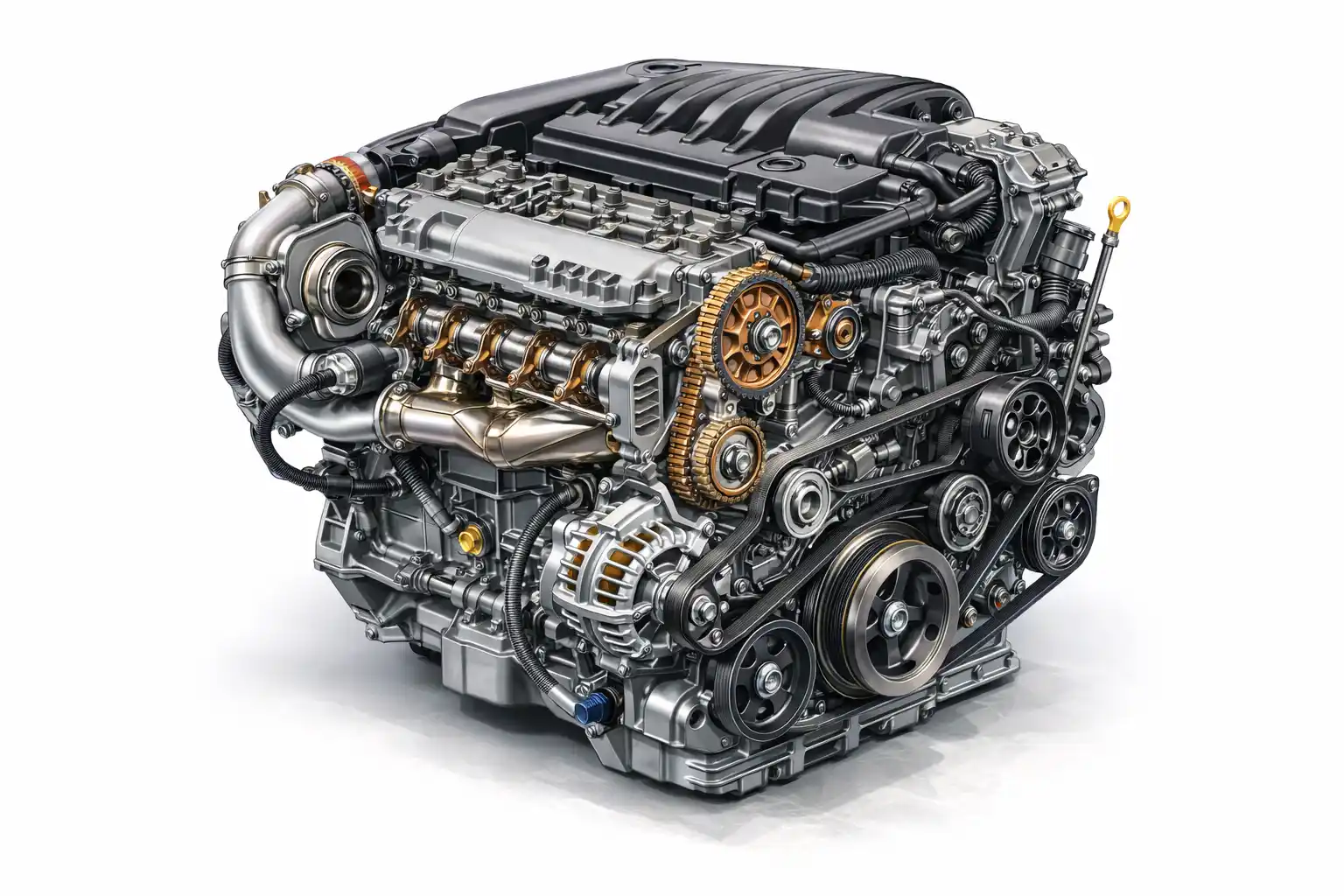
Introduction about car engine
Early in the morning, you press the start button of your car, and it starts within seconds. Have you ever thought about how it started? The solution is hidden under your car hood, i.e., the car engine. Inside the car engine, fuel like petrol or diesel or CNG, etc., mixes with air to create a controlled combustion, and the piston begins to move to generate power. That power turns the crankshaft and moves the wheels.
A car engine is the heart of the vehicle, silently converting energy into the force that drives your car forward. In this blog, you will find an overview of car engines
What is car Engine?
The car engine is a device that converts chemical energy, such as petrol, or diesel, or natural gas, into mechanical energy (motion) to perform useful work.
In simple terms, the engine generates power that moves the vehicle and operates its various systems.
Just like the human heart pumps blood to different parts of the body, the engine produces and distributes power to different components of a vehicle, enabling it to run smoothly and efficiently. That is the reason why I called the engine the heart of the car earlier.
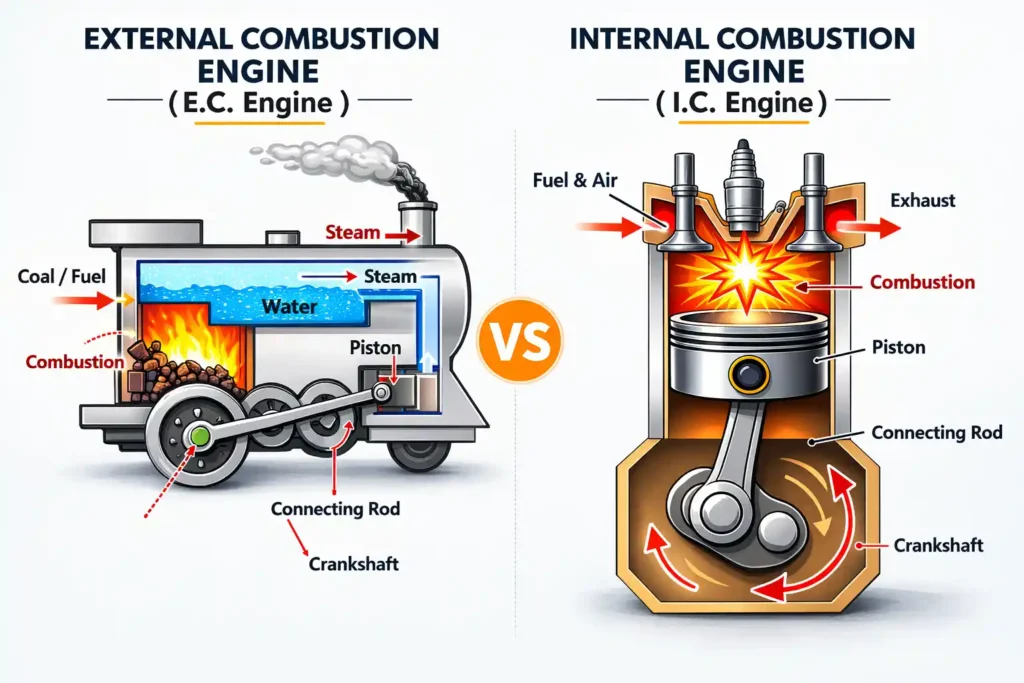
Before that Generally, engines are broadly classified based on how they generate power. The major categories include internal combustion engines, external combustion engines, and jet engines. However, in automotive field, the primary focus is on internal combustion engines. Before exploring car engines in detail, let us first understand what internal combustion and external combustion engines are and how they differ.

What is Combustion?
Combustion is a process where fuel like petrol, diesel, or natural gas mixes with oxygen and releases the energy by igniting a spark in the form of heat; simply, it is the process of burning fuel to produce energy.
- Internal Combustion Engine (IC Engine)
- The car engines is one of most common applications of the internal combustion engine, which is a type of heat engine in which combustion (burning of fuel) takes place inside the engine cylinder. Most modern cars, bikes, and commercial vehicles use internal combustion engines.
- Examples: Petrol engines and diesel engines.
- These internal combustion engines are used in cars, bikes, trucks, Generators, etc.
2. External Combustion Engine (EC Engine)
- In an external combustion engine, fuel burns outside the engine cylinder. The heat produced is used to generate steam or another working fluid, which then drives a piston or turbine to produce power.
- Example: Steam engine.
- These external combustion engines are used in steam Locomotives (Old Trains), Thermal Power Plants, Nuclear Power Plants, etc.
Types of Car Engines
The automotive industry offers a wide range of car engine types to meet various needs such as performance, fuel efficiency, affordability, and environmental sustainability. Each engine type work with different mechanism and fuel system and have their advantages depending on driving conditions and user requirements.
Car engines can be classified into the following categories:
• Type of fuel used (Petrol, Diesel, CNG)
• Power source (Internal Combustion Engine and Electric Motor)
• Number of strokes (Two-stroke and Four-stroke)
• Number of cylinders (Single-cylinder and Multi-cylinder)
• Arrangement of cylinders (Inline, V-type, Boxer, etc.)
1. Based on type of fuel used
i. Petrol Engine:
A petrol engine is one of the most commonly used car engine types, especially in hatchbacks and compact sedans. These engines are known for their smooth performance, lower noise levels. It operates by mixing petrol with air inside the combustion chamber, where a spark plug ignites the mixture to produce power. The controlled explosion pushes the piston downward, converting chemical energy into mechanical energy that drives the wheels.
Nowadays, these petrol engines use advanced technologies like MPFI (Multi-Point Fuel Injection) and turbocharging to improve the efficiency and power output from petrol engines. Because these will give better performance and suitability for short-distance driving compared to normal petrol engines.
Fuel used: Petrol as input
Advantages:
- Smooth Performance
- Initial cost is low
- Better for city driving
Disadvantages:
- Lower fuel efficiency than diesel
- Less torque
The common petrol engine cars are:
- Maruti Suzuki Swift
- Hyundai i20
ii. Diesel Engines:
A diesel engine is used in SUVs, trucks, buses, etc. This generates power by compressing the air inside its cylinder with high pressure and temperature. At the end of the compression stroke, diesel fuel is directly injected into hot compressed air and ignites automatically due to high temperature. Unlike petrol engines, which rely on spark plugs to ignite, diesel engines actually get their combustion by themselves just because they rely on diesel engines on the compression ignition principle.
The diesel engine produces a high torque at lower RPMs, where it is suitable for heavy load applications, towing, and long journeys.
The modern diesel engines use advanced technologies like Common Rail Direct Injection (CRDi) and turbocharging, all of which are designed to boost power, cut down on noise, and make emissions more manageable. But diesel engine vehicles are more expensive but economical in the long run for drivers who travel longer distances frequently.
Advantages:
- Better fuel efficiency
- High torque (good for SUVs & heavy vehicles)
- Ideal for long-distance driving
- Longer engine life
Disadvantages:
- Higher vehicle cost
- Slightly noisy compared to petrol
- Higher maintenance cost
- Diesel vehicles may face stricter emission norms
The common diesel engine cars are
- Hyundai creta Diesel
- Mahindra Scorpio-N
- Tata Harrier
- Tata Curvv Diesel
iii. CNG Engine:
A CNG engine uses Compressed Natural Gas as fuel and works similarly to a petrol engine. The air and CNG mixture is ignited by a spark plug inside the combustion chamber to generate power. CNG vehicles are mainly used for city commuting because of their low running cost and reduced emissions. Many CNG cars in India are bi-fuel vehicles, allowing drivers to switch between petrol and CNG modes.
CNG engines produce fewer harmful emissions compared to petrol and diesel engines, making them more environmentally friendly. However, they may deliver slightly lower power output due to the nature of gaseous fuel combustion.
Advantages:
- Very low running cost
- Cleaner fuel with lower emissions
- Ideal for daily city commuting
Disadvantages:
- Reduced boot space (due to CNG cylinder)
- Slightly lower power
- Limited CNG stations in some areas
The common CNG engine cars are:
- Tata Tiago CNG
- Maruti Suzuki Wagon R CNG
2. Based on Type of Power Source
i. Internal Combustion Engine (ICE):
An Internal Combustion Engine (ICE) generates power by burning fuel such as petrol or diesel inside the engine cylinder. The air-fuel mixture is ignited inside the combustion chamber, producing high-pressure gases that push the piston downward. This leads to linear motion being converted into rotational motion through the crankshaft, which drives the vehicle’s wheels. ICE vehicles have been widely used for decades due to their strong performance and easily available fuel.
Advantages:
- Long driving range
- Quick refuelling
- Strong high-speed performance
Disadvantages:
- Produces emissions
- Higher fuel cost in long term
- More maintenance required
The Common ICE Car engines are:
- Maruti Suzuki Swift
- Hyundai Creta
ii. Electric Motor:
An electric motor gives the power to the vehicle by using electricity stored in battery packs. Unlike internal combustion engines, electric motors do not burn fuel. Electrical energy is directly converted into mechanical energy to rotate the wheels. Electric vehicles (EVs) are known for instant torque delivery, silent operation. With the growth of charging infrastructure, EVs are becoming increasingly popular in urban areas.
Advantages:
- Zero tailpipe emissions
- Low running cost
- Less maintenance
Disadvantages:
- Higher initial cost
- Charging takes time
- Limited charging stations (in some areas)
Common Electric Cars are:
- MG ZS EV
- Tata Nexon EV
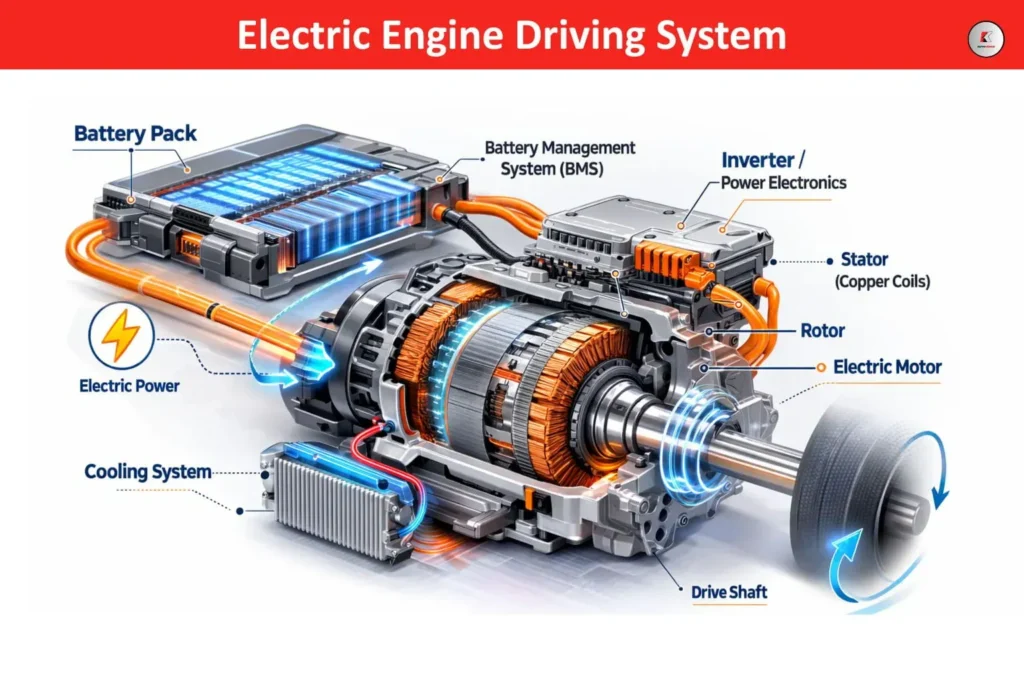
iii. Hybrid Engines
A hybrid engine is another type of engine that combines an internal combustion engine (usually petrol) with an electric motor. These engines are designed to improve fuel efficiency and reduce emissions while maintaining good performance. In a hybrid vehicle, both the petrol engine and the electric motor work together depending on driving conditions. At low speeds, the electric motor may power the vehicle, while at higher speeds, the petrol engine operates. During acceleration, both systems can function together to deliver better performance.
Hybrid engines use regenerative braking technology, which converts braking energy into electricity to recharge the battery automatically. Because of their improved mileage and lower environmental impact, hybrid engines are becoming increasingly popular among modern car buyers.
Advantages:
- Better fuel efficiency than petrol engines
- Lower emissions
- Smooth and quiet operation
Disadvantages:
- Higher initial cost
- Complex system
- Battery replacement cost can be expensive
The common hybrid car engines used are:
- Toyota Innova Hycross Hybrid
- Honda City e:HEV
3. Based on Number of Strokes
i. Two-Stroke Engine:
A two-stroke engine completes one power cycle in two piston movements (one crankshaft revolution). In this type of engine, the intake and exhaust processes occur simultaneously. Two-stroke engines are simple in construction and lighter in weight. However, they are less fuel-efficient and produce more emissions compared to four-stroke engines. In modern cars, two-stroke engines are rarely used.
Advantages:
- Simple design
- Lightweight
- Higher power-to-weight ratio
Disadvantages:
- Poor fuel efficiency
- Higher emissions
- More wear and tear
The common hybrid engine vehicles are:
- Yamaha RX100
- Bajaj Chetak
ii. Four-Stroke Engine:
A four-stroke engine completes one power cycle in four piston movements (two crankshaft revolutions): intake, compression, power, and exhaust. This design ensures better fuel efficiency and cleaner combustion. Almost all modern cars use four-stroke engines because they are more efficient and environmentally friendly.
Advantages:
- Better fuel efficiency
- Lower emissions
- Longer engine life
Disadvantages:
- More complex design
- Slightly heavier than two-stroke
Common Four stroke engine +Cars:
- Maruti Suzuki Swift
- Hyundai Creta
4. Based on Number of Cylinders
i. Single-Cylinder Engine:
A single-cylinder engine has only one cylinder and one piston. It is simple and economical but may produce more vibrations. These engines are commonly used in motorcycles and small vehicles rather than modern cars.
Advantages:
- Simple construction
- Low cost
- Easy maintenance
Disadvantages:
- More vibration
- Limited power output
ii. Multi-Cylinder Engine:
A multi-cylinder engine contains two or more cylinders (such as 3, 4, 6, or 8 cylinders). More cylinders provide smoother operation and higher power output. Most modern cars use 3-cylinder or 4-cylinder engines, while performance cars may use 6 or 8 cylinders.
Advantages:
- Smoother performance
- Higher power output
- Better balance
Disadvantages:
- Higher cost
- Slightly more complex maintenance
5. Arrangement of Cylinders
i. Inline Engine:
An inline engine has all cylinders arranged in a straight line. It is the most common configuration in modern cars due to its compact design and lower manufacturing cost.
Advantages:
- Simple design
- Cost-effective
- Easy maintenance
Disadvantages:
- May become longer with more cylinders
ii. V-Type Engine:
In a V-type engine, cylinders are arranged in two banks forming a “V” shape. This design allows more cylinders in a compact space and provides higher power output.
Advantages:
- Compact for high cylinder count
- High performance
Disadvantages:
- More complex design
- Higher cost
iii. Boxer Engine:
A boxer engine has cylinders arranged horizontally opposite to each other. This design lowers the center of gravity and improves vehicle stability.
Advantages:
- Better balance
- Lower center of gravity
- Smooth operation
Disadvantages:
- Complex design
- Higher maintenance cost
These are only few type of engines based on arrangement, if you want more comment below I will write in detail
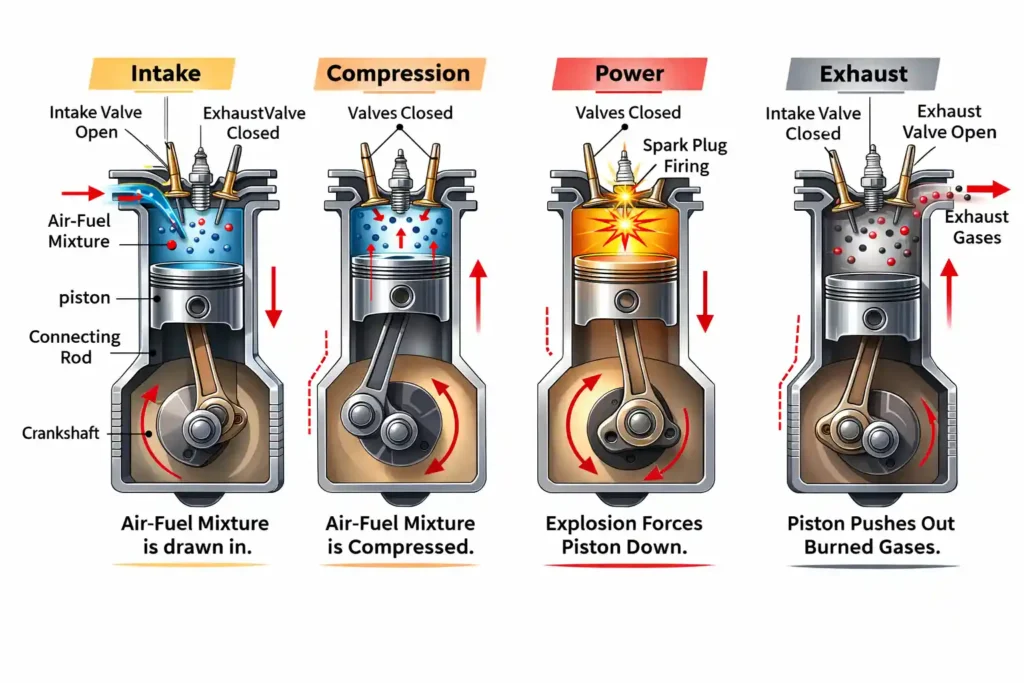
Four stroke principle
A four-stroke engine completes one power cycle in four piston movements (two crankshaft revolutions). It is the most commonly used engine type in modern cars because of its better fuel efficiency and lower emissions.
The four strokes are:
1️. Intake Stroke
The intake valve opens, and the piston moves downward. A mixture of air and fuel (in petrol engines) or only air (in diesel engines) enters the combustion chamber.
2️. Compression Stroke
The intake valve closes, and the piston moves upward, compressing the air-fuel mixture. Compression increases the temperature and pressure inside the cylinder.
3️. Power Stroke
The spark plug ignites the compressed mixture (in petrol engines), or fuel is injected (in diesel engines). The explosion pushes the piston downward, producing power.
4️. Exhaust Stroke
The exhaust valve opens, and the piston moves upward again, pushing out the burnt gases from the cylinder.
Main parts of Car engine:
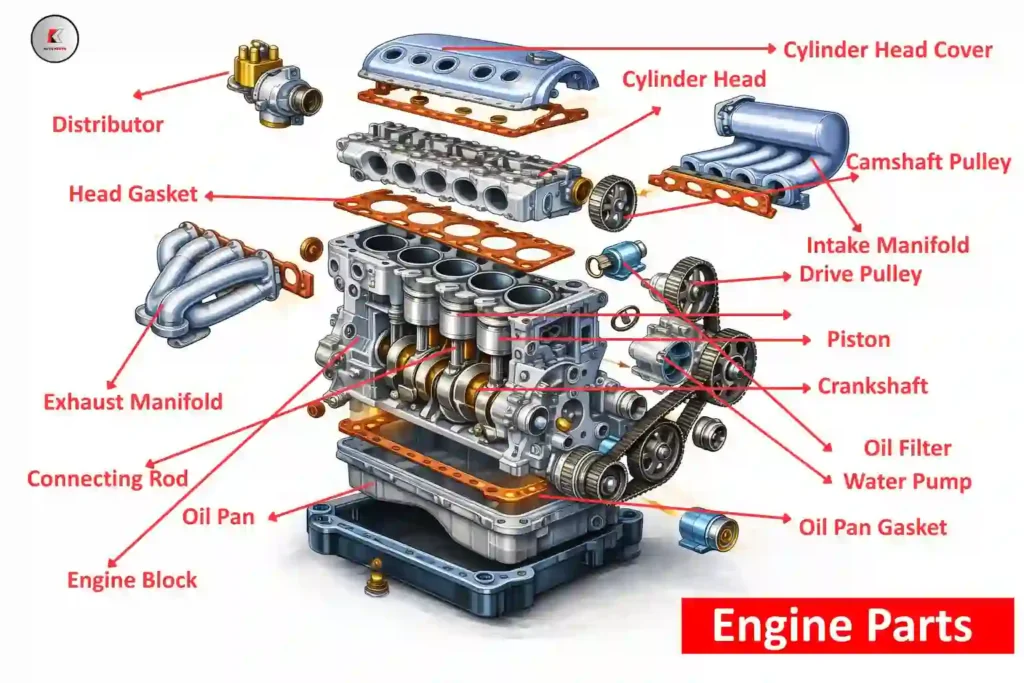
1. Cylinder Block
The cylinder block is the main body of the engine. It contains three main parts, and they are the cylinders where the piston moves up and down, the port valve opening for valves, and the passages for the flow of cooling water. It also houses coolant passages and oil galleries. It is made from cast iron or aluminum & its alloys. The crankcase is fixed to its bottom.
2. Cylinder Head
The cylinder head is mounted on top of the cylinder block and closes the upper part of the cylinders. This cylinder head forms the combustion chamber in which the air–fuel mixture burns and creates power. The cylinder head houses intake and exhaust valves that control the flow. It also contains the spark plug in petrol engines and the fuel injector in diesel engines, which helps to get Ignition in the combustion process, . Additionally, coolant passages also inside the cylinder head help remove heat and prevent engine overheating.
3. Piston
The piston is a cylindrical component that moves up and down inside the cylinder. The piston plays an important role in generating the power from the engine. This will compress the gases and expand the gases by pushing the piston upwards and downwards in the combustion process to produce mechanical power. This motion is transferred to the connecting rod and crankshaft. Pistons must withstand high temperatures and pressures inside the engine. They are usually made from lightweight aluminum alloys to reduce engine weight and improve heat dissipation.
4. Piston Rings
Piston rings are fitted in grooves around the outer surface of the piston. Their main function of piston rings is to seal the combustion chamber and prevent leakage of gases in the combustion chamber. They also control the amount of lubricating oil between the piston and cylinder wall. Additionally, piston rings help transfer heat from the piston to the cylinder wall. Typically, an engine piston has two compression rings and one oil control ring.
5. Connecting Rod
The connecting rod is connected with the piston and crankshaft. The main function of the connecting rod is when the piston moves upwards and downwards in the combustion process. This linear motion is converted into rotating motion, and the vehicle will move. The connecting rod has two main ends. The small end is connected to the piston with the help of the piston pin, and the big end is connected to the crankshaft.
6. Crankshaft
The crankshaft is a rotating shaft that converts the reciprocating motion of the pistons into rotational motion. This rotational motion is used to drive the vehicle through the transmission system. The crankshaft contains crankpins and counterweights to balance the engine and reduce vibrations. It rotates continuously while the engine is running. Crankshafts are typically manufactured from forged steel or cast iron.
7. Camshaft
The camshaft controls the opening and closing of engine valves. It contains specially shaped lobes that push the valves open at precise times during the engine cycle. Proper valve timing ensures efficient intake of air–fuel mixture and removal of exhaust gases. The camshaft is driven by the crankshaft through a timing belt or timing chain. Accurate camshaft operation is essential for smooth engine performance.
8. Valves
Engine valves are main parts to control the flow of gases inside the cylinder. The intake valve allows the air–fuel mixture into the cylinder in the intake stroke, also called the suction stroke. The exhaust valve allows the burned gases to exit after completion of combustion. These valves open and close at precise intervals, which is controlled by the camshaft. The valves should withstand high temperatures and pressures during engine operation.
9. Flywheel
A flywheel is also an important component in the engine. This part is mainly used for the transmission system, and it is connected to the crankshaft. The main function of a flywheel is to maintain a constant engine speed.
10. Crankcase
The crankcase is the lower portion of the engine that encloses and supports the crankshaft. It protects internal rotating components and helps maintain proper lubrication. The crankcase also provides structural strength to the engine assembly. In many engines, the crankcase is integrated with the cylinder block.
11. Oil Pan
The oil pan, also called the sump, is located at the bottom of the engine. It stores the lubricating oil used to reduce friction between moving engine parts. Oil from the sump is circulated throughout the engine by the oil pump. The oil pan also helps cool the oil before it is recirculated.
12. Intake & Exhaust Manifold
The intake manifold distributes the air or air–fuel mixture evenly to each cylinder. It ensures that all cylinders receive the correct amount of air for efficient combustion. The intake manifold is connected to the throttle body or carburetor in petrol engines.
The exhaust manifold collects exhaust gases from the cylinders and directs them into the exhaust system. It is designed to withstand very high temperatures. The manifold helps efficiently remove burned gases from the engine.
13. Timing Belt
The timing belt synchronizes the rotation of the crankshaft and camshaft. This ensures that the engine valves open and close at the correct time during the engine cycle. Proper timing is essential for efficient combustion and engine performance.
15. Spark Plug (Petrol Engine Only)
The spark plug is Ignites the air-fuel mixture during the power stroke, so combustion will take place.
16. Fuel Injector
This Sprays fuel into the combustion chamber in modern engines (both petrol & diesel).
Important Engine Terms
1️. Horsepower (HP)
Horsepower is a unit of power that indicates how fast an car engine can perform work. In simple terms, it represents the maximum speed capability of a vehicle.
Higher horsepower generally means:
- Better top speed
- Stronger acceleration at high speeds
For example, a car with 120 HP will typically be faster than a car with 80 HP (if other factors are similar).
HP is related to torque and RPM.
2. Torque (Nm)
Torque is the rotational force produced by the car engine or any other engine. It determines how strongly the engine can pull.
Higher torque means:
- Better pickup
- Strong pulling power
- Good performance for heavy vehicles
Diesel engines usually produce more torque than petrol engines.
3️. RPM (Revolutions Per Minute)
RPM indicates how many times the engine’s crankshaft rotates in one minute.
Higher RPM:
- More power generation
- Higher speed potential
Low RPM:
- Better fuel efficiency
- Smooth city driving
4️. Engine Capacity (cc)
Engine capacity (measured in cubic centimeters – cc) refers to the total volume of all cylinders in an engine.
Higher cc usually means:
- More air-fuel mixture
- More power potential
Example:
- 1000 cc engine = Small car engines
- 2000 cc engine = SUV car engines
5️. Compression Ratio
Compression ratio is the ratio between the maximum and minimum volume inside the cylinder.
Higher compression ratio:
- Better efficiency
- More power
- Used in diesel engines
Petrol engines generally have lower compression ratios compared to diesel engines.
6️. Turbocharger
A turbocharger is a device that forces more air into the engine using exhaust gases. More air allows more fuel to burn, increasing power without increasing engine size.
Benefits of turbocharging:
- Higher power output
- Better efficiency
- Smaller engine with big performance
Modern cars use turbo engines for better performance and fuel economy.
Engine Supporting Systems
Apart from the main engine components, several supporting systems ensure smooth, efficient, and safe engine operation. These systems work together to maintain temperature, reduce friction, supply fuel, and remove exhaust gases.
1. Cooling System
The cooling system prevents the engine from overheating by maintaining an optimal operating temperature. During combustion, the engine generates a large amount of heat. The cooling system circulates coolant around the engine block to absorb heat and release it through the radiator.
Main components: Radiator, coolant, water pump, thermostat.
2. Lubrication System
The lubrication system reduces friction between moving engine parts by supplying engine oil. It prevents wear and tear, reduces heat, and ensures smooth engine operation.
Main components: Oil pump, oil filter, oil sump, engine oil.
3. Fuel System
The fuel system stores and supplies fuel to the engine in the correct quantity and pressure. It ensures proper mixing of fuel and air for efficient combustion.
Main components: Fuel tank, fuel pump, fuel injector/carburetor, fuel filter.
4. Exhaust System
The exhaust system removes burnt gases from the engine after combustion. It also reduces harmful emissions and controls noise.
Main components: Exhaust manifold, catalytic converter, muffler.
FAQ’s
What is a car engine?
The car engine is a device that converts chemical energy, such as petrol, or diesel, or natural gas, into mechanical energy (motion) to move vehicle. In most cars, this is done through combustion inside cylinders called internal combustion engine
What are the parts of the car engine?
The engine consists of different parts which helps to operate engine efficiently. The different parts are like cylinder block, cylinder head, piston, piston Rings, connecting rod, crankshaft, camshaft, intake valve, exhaust valve, spark plug, fuel injector, flywheel, oil pan etc.
Which engine is better: petrol or diesel?
Petrol car engines are better for city driving and lower initial cost, while diesel engines offer better fuel efficiency and higher torque for long-distance and heavy vehicles.
What is engine capacity (cc)?
Engine capacity (cc) is the total volume of all the cylinders in an engine, measured in cubic centimeters (cc). It represents the maximum amount of air–fuel mixture the engine cylinders can hold during one cycle. A higher engine capacity usually means the engine can burn more fuel and produce more power.
What is the difference between horsepower and torque?
Torque is the rotational force produced by the engine that helps turn the crankshaft and move the vehicle. Horsepower is the rate at which work is done, meaning how quickly the engine can use that torque to produce power. In simple terms, torque provides pulling strength, while horsepower determines the vehicle’s speed and performance over time. Torque is important for acceleration and heavy loads, while horsepower is important for higher speeds and overall engine performance.