

Have you ever wondered what really occurs when you turn your car’s key or press the start button?
Within a fraction of seconds, the hundereds of the engine parts will work. Piston moves upwards and downwards for a thousand of time in a minute and also fuel mixes with air; spark will ignite the fuel mixture creates the combustion.
Yet most drivers use their cars every day without understanding what is happening under the car hood.
Whether you’re a car enthusiast, a mechanical engineering student, preparing for an interview, or simply curious about how vehicles work, understanding a petrol engine is one of the most important fundamentals of automotive technology.
In this complete guide, you’ll learn what a petrol engine is, how it works, its major components, advantages and disadvantages, modern technologies such as turbocharging and direct injection, common problems, maintenance tips, and how petrol engines compare with diesel engines.
Let’s start by understanding the machine that has powered the automotive world for more than a century.
What is a Petrol Engine?
A petrol engine is a spark-ignition internal combustion engine that uses petrol (gasoline) as fuel. It converts the chemical energy stored in fuel into mechanical energy through controlled combustion inside the engine cylinder.
Unlike diesel engines, which rely on compression ignition, This engines use a spark plug to ignite the air-fuel mixture.
Petrol engines are commonly found in:
- Cars like Honda city, Skoda slavia etc.
- Bikes like hunter, TVS raider etc.
- Scooters like Activa
- Portable generators
- Boats
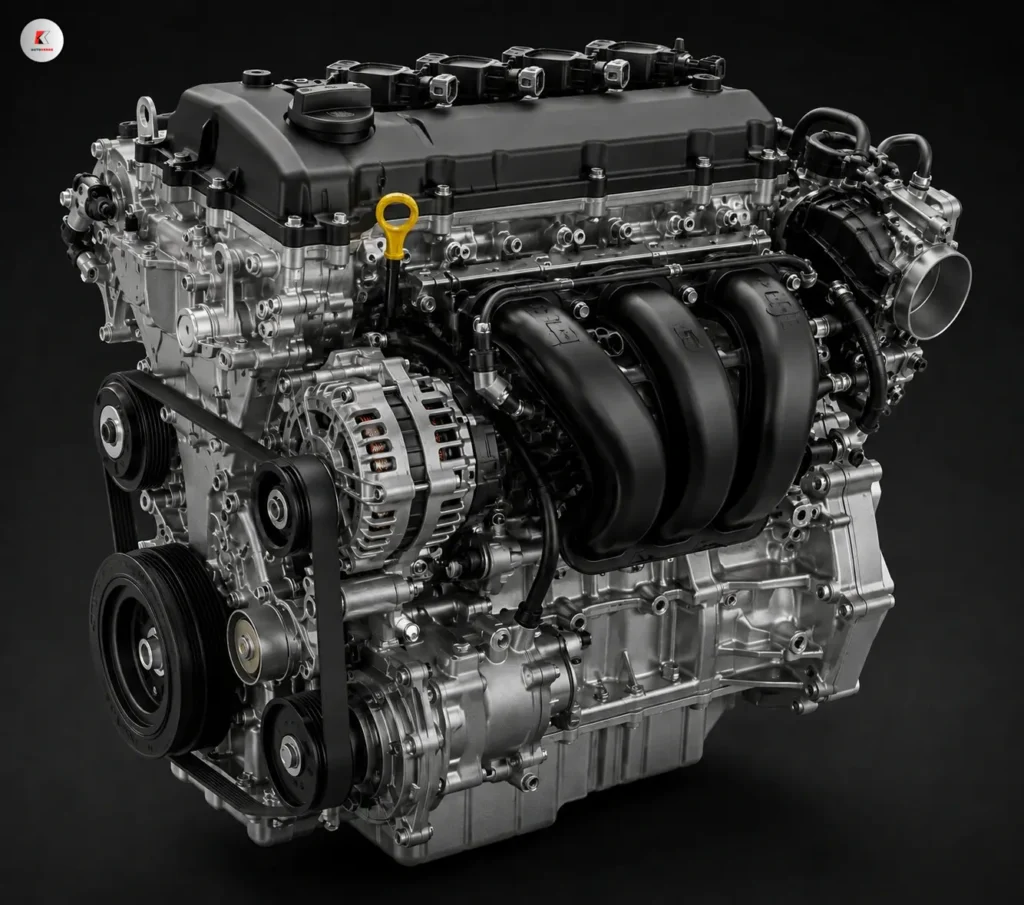
History of Petrol Engine
The development of the petrol engine marked a major breakthrough in the field of transportation and mechanical engineering. Its history was begun in the late 19th century. The engineers are thought to invent the more efficient alternative option for steam engines, and the process was started. In the year 1876, the German engineer Nikolaus Otto invented the first four-stroke internal combustion engine. This engine consist of intake, compression, power and exhaust strokes, which leads to the most efficient engines.
The continuation of Otto’s work, Gottlieb Daimler and Wilhelm Maybach developed a compact, high-speed petrol engine in the year of the 1880s. They also improved fuel delivery by designing an effective carburetor that converted liquid fuel into a combustible air-fuel mixture. These innovations made petrol engines smaller, lighter, and more suitable for transportation applications.
A few years later, Karl Benz utilized a gasoline-powered engine to create one of the world’s first practical automobiles. His invention demonstrated the potential of petrol engines for personal transportation and laid the groundwork for the automotive industry. During the early twentieth century, manufacturers such as Ransom E. Olds and Henry Ford revolutionized vehicle production through assembly-line manufacturing techniques. As a result, petrol-powered vehicles became affordable and widely available to the general public.
Throughout the twentieth century, petrol engines continued to improve in performance, reliability, and efficiency. Engineers introduced technologies such as electric ignition systems, improved valve mechanisms, turbocharging, and multi-valve cylinder heads to increase power output and fuel economy. Advances in materials and manufacturing methods also enhanced engine durability and reduced maintenance requirements.
In recent decades, growing environmental concerns and stricter emission regulations have driven further innovation. Traditional carburetors have largely been replaced by electronic fuel injection systems, which provide more precise control of the air-fuel mixture and improve combustion efficiency. Modern petrol engines now incorporate advanced technologies such as direct fuel injection, variable valve timing, turbocharging, and hybrid-electric integration. These developments have significantly reduced fuel consumption and emissions while maintaining high levels of performance.
Today, the petrol engine remains one of the most widely used power sources in automobiles worldwide. Although alternative energy technologies are becoming increasingly important, continuous advancements ensure that petrol engines remain efficient, reliable, and relevant in modern transportation.
How Does a Petrol Engine Work?
A gasoline engine operates on the Otto Cycle, which consists of four strokes:
- Intake Stroke
- Compression Stroke
- Power Stroke
- Exhaust Stroke
These four strokes complete one operating cycle. This cycle consists of two-revolutions and four strokes. Each stroke is a half revolution.
1. Intake Stroke
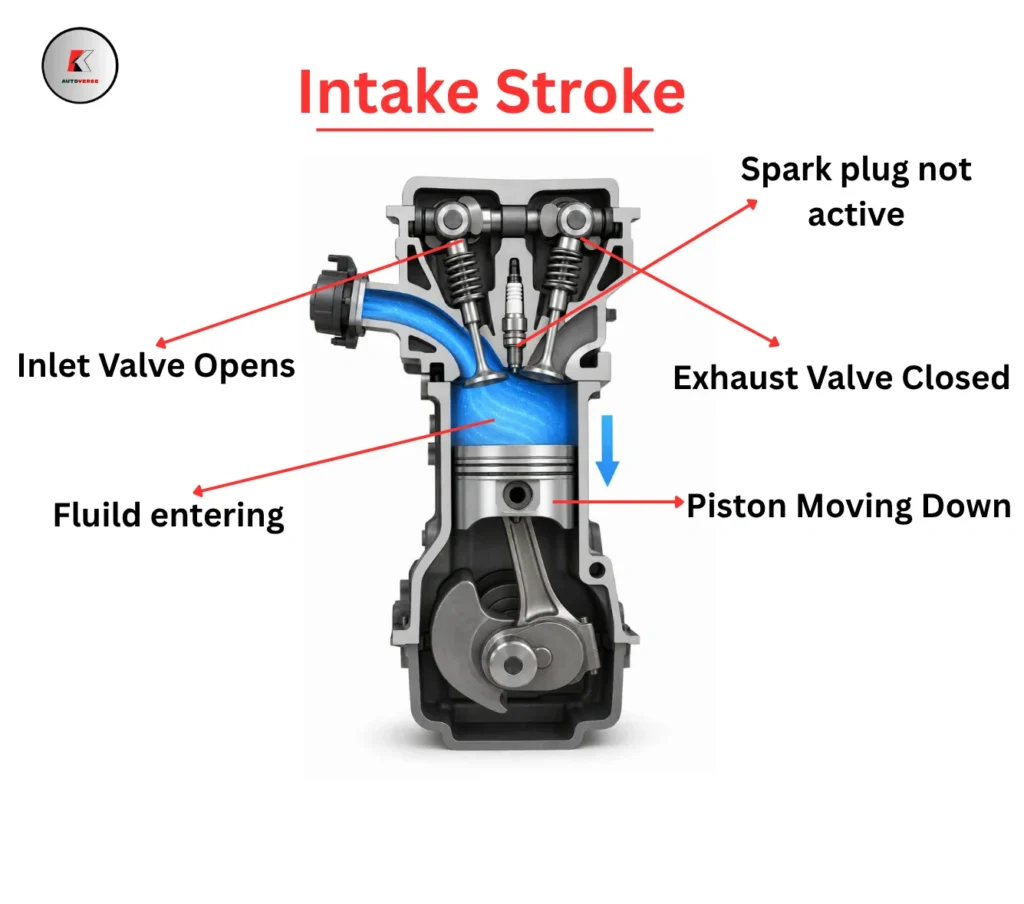
The intake stroke is also called as the suction stroke. During the intake stroke:
- The intake valve of the engine will open.
- Piston move from upwards (Top Dead Centre) to downwards (Bottom Dead centre) .
- Air-fuel mixture enter into the cylinder.
This process fills the cylinder with combustible mixture.
How air fuel mixture entres into cylinder?
The movement of the piston towards downside creates a vacuum in a cylinder, resulting in drawing the air-fuel mixture into the combustion chamber.
2. Compression Stroke
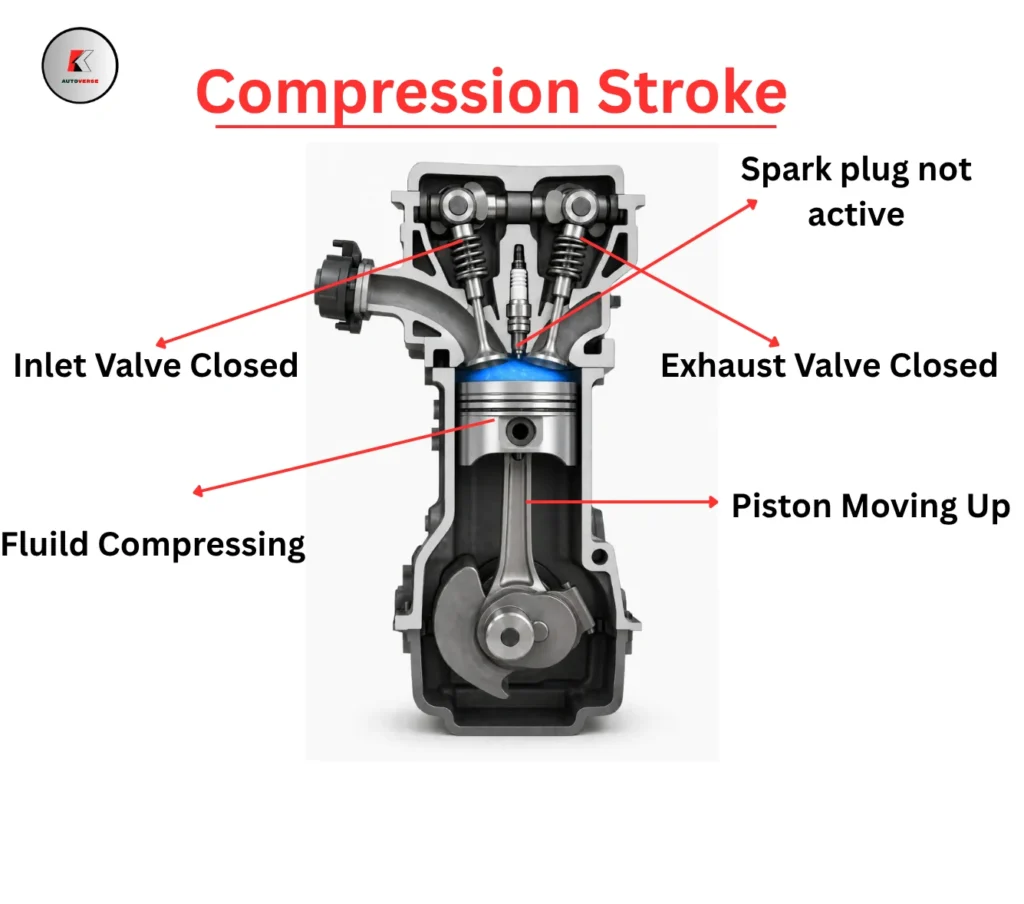
During compression:
- Both valves remain closed.
- Piston moves towards upward.
- Air-fuel mixture gets compressed.
Compression increases pressure and temperature inside the cylinder.
Why Compression is Important?
Higher compression will improves combustion efficiency, produces more power, reduces fuel wastage
3. Power Stroke
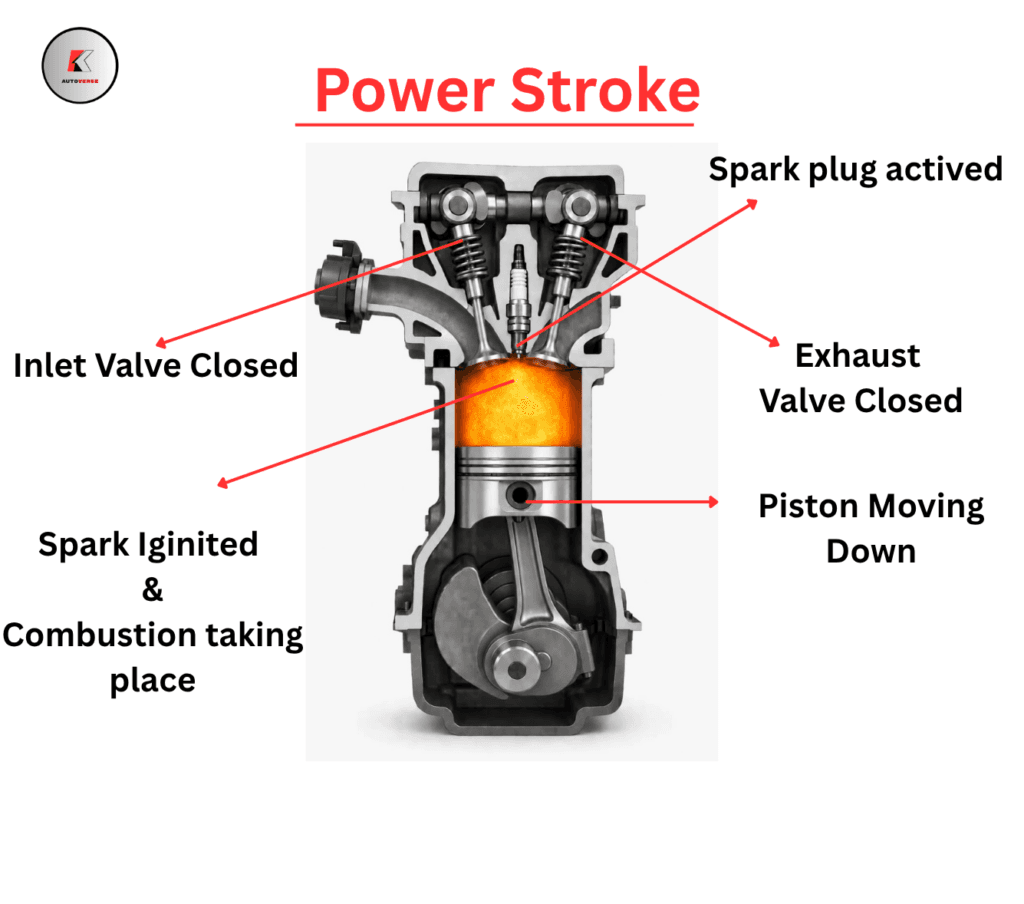
This is the most important stage. During the power stroke:
- Spark plug generates a spark.
- Compressed mixture ignites.
- Rapid combustion occurs.
- High-pressure gases push the piston downward.
This downward movement generates useful power.
Why It Is Called the Power Stroke?
Out of all four strokes, only this stroke produces mechanical power.
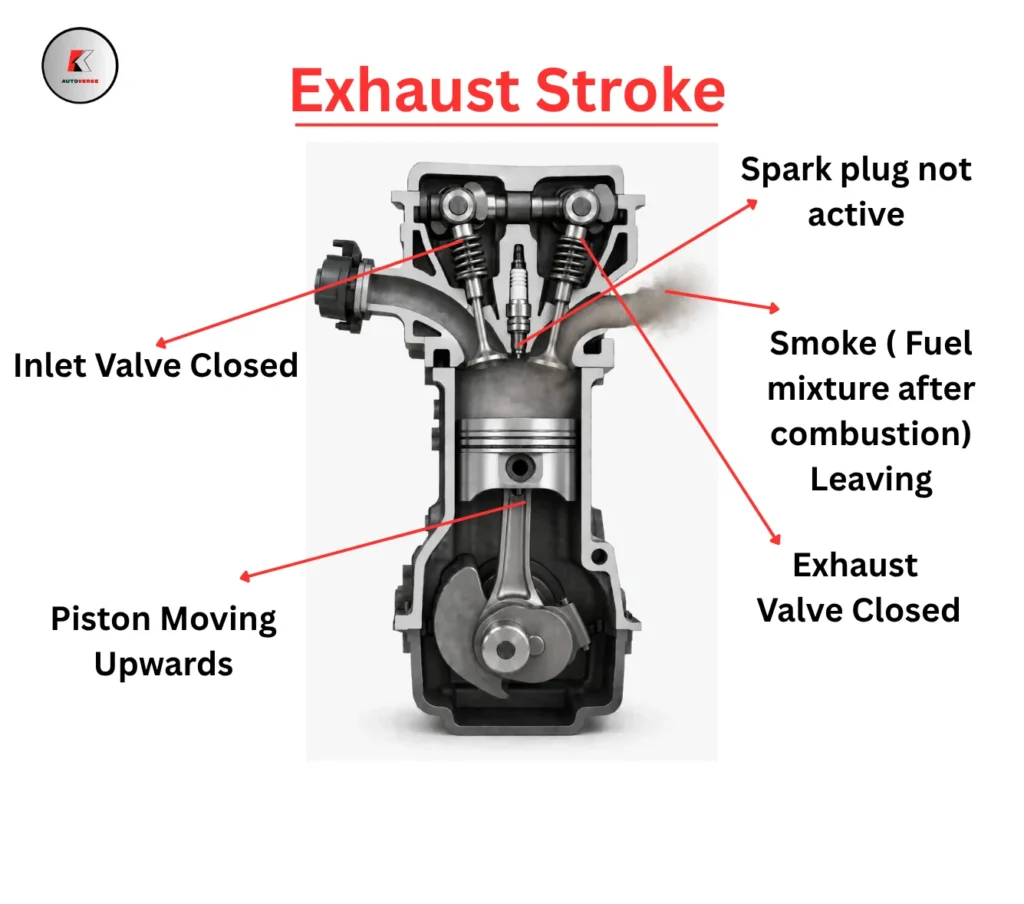
4. Exhaust Stroke
This is final stroke of process. During exhaust:
- Exhaust valve opens.
- Piston moves upward.
- Burned gases leave the cylinder.
The engine is now ready for the next cycle.
Petrol Engine Working Process in Simple Words
- Fuel enters the cylinder.
- Mixture gets compressed.
- Spark ignites the mixture.
- Explosion pushes piston down.
- Exhaust gases leave the cylinder.
- Process repeats thousands of times per minute.
This continuous cycle generates rotational power that ultimately drives vehicle wheels.
Four Stroke Engine step-by-step animation
Thermodynamic Cycle of a Petrol Engine (Otto Cycle)
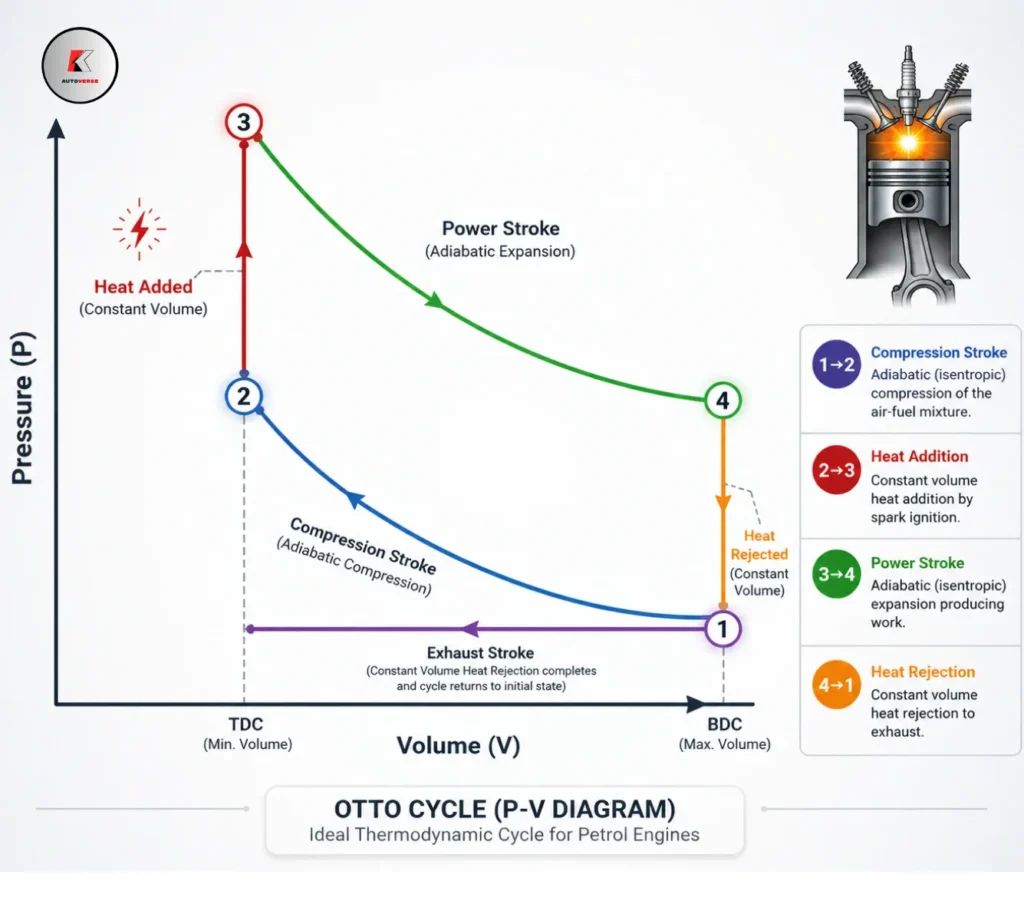
The Otto cycle is the ideal thermodynamic cycle that describes the operation of a spark-ignition (SI) petrol engine. Named after Nikolaus Otto, who developed the first practical four-stroke engine in 1876, the Otto cycle consists of four distinct processes that convert the chemical energy of fuel into mechanical work. In an actual petrol engine, the cycle is completed through the intake, compression, power, and exhaust strokes, while the ideal Otto cycle assumes perfect conditions for thermodynamic analysis.
Processes of the Otto Cycle
- Process 1–2: Isentropic Compression During this process, the piston moves from Bottom Dead Center (BDC) to Top Dead Center (TDC), compressing the air-fuel mixture inside the cylinder. No heat is transferred to or from the system, making it an isentropic (adiabatic and reversible) compression process. As a result, both pressure and temperature increase significantly but decreases.
- Process 2–3: Constant-Volume Heat Addition Near TDC, the spark plug ignites the compressed air-fuel mixture. Combustion occurs rapidly, and heat is added at nearly constant volume because the piston has very little time to move. This causes a sharp rise in pressure and temperature within the cylinder.
- Process 3–4: Isentropic Expansion (Power Stroke) The high-pressure combustion gases expand and push the piston from TDC to BDC. This expansion process is considered isentropic, meaning no heat transfer occurs. The expanding gases perform useful work on the piston, producing the engine’s power output.
- Process 4–1: Constant-Volume Heat Rejection At the end of the power stroke, heat is rejected from the working fluid at constant volume. This process represents the release of exhaust gases and the return of the system to its initial state, completing the cycle.
Otto Cycle Diagram Formula
Where:
- η = Thermal efficiency of the Otto cycle
- r = Compression ratio
- γ = Ratio of specific heats (Cp/Cv)
Key Characteristics of the Otto Cycle
- Used as the ideal cycle for petrol (gasoline) engines.
- Heat addition and heat rejection occur at constant volume.
- Efficiency increases with higher compression ratios.
- Forms the theoretical basis for modern spark-ignition engines.
- Simpler and more efficient than many early engine cycles.
The Otto cycle is the fundamental thermodynamic model for petrol engines. It consists of isentropic compression, constant-volume heat addition, isentropic expansion, and constant-volume heat rejection. By converting the chemical energy of fuel into mechanical work through these processes, the Otto cycle provides the theoretical foundation for the operation and performance analysis of modern petrol engines.
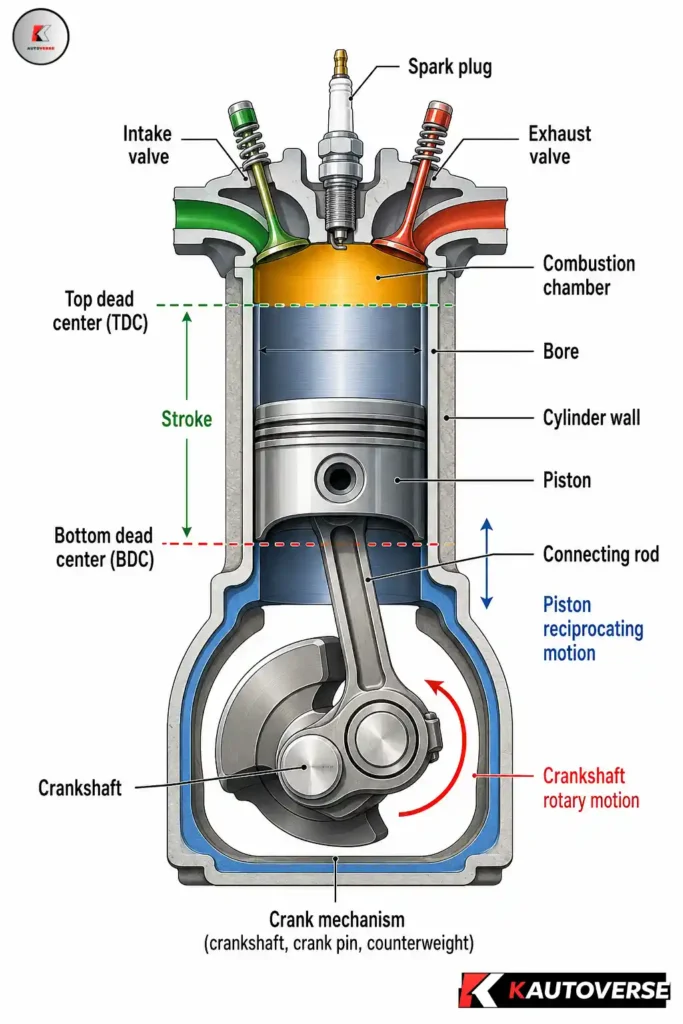
Main Components of a gasoline Engine
Understanding engine components helps you understand how the engine works.
1. Spark Plug
The spark plug is an electrical device located at the top of the cylinder head. Its primary function is to ignite the compressed air-fuel mixture inside the combustion chamber by producing a high-voltage electric spark. This ignition occurs near the end of the compression stroke and initiates combustion, generating the pressure required to drive the piston downward during the power stroke. A properly functioning spark plug is essential for efficient engine performance, fuel economy, and smooth operation.
2. Piston
The piston is a cylindrical component that moves up and down within the cylinder. It receives the force generated by the expanding combustion gases and transfers this force to the connecting rod. The piston also compresses the air-fuel mixture during the compression stroke and helps expel exhaust gases during the exhaust stroke. Its continuous reciprocating motion is fundamental to engine operation.
3. Connecting Rod
The connecting rod is a mechanical link between the piston and the crankshaft. It transfers the force generated by combustion from the piston to the crankshaft while allowing the conversion of reciprocating motion into rotary motion. The connecting rod must withstand high compressive and tensile forces during engine operation and is therefore manufactured from strong materials such as forged steel.
4. Crankshaft
The crankshaft is the main rotating shaft of the engine and is located in the crankcase. It converts the reciprocating motion of the piston into continuous rotary motion through the action of the connecting rod. The crankshaft transmits the engine’s power to the transmission and ultimately to the vehicle’s wheels. It is one of the most critical components in the power transmission process.
5. Intake Valve
The intake valve is a valve mechanism that controls the entry of the air-fuel mixture into the cylinder. During the intake stroke, the valve opens while the piston moves downward, creating a vacuum that draws the mixture into the combustion chamber. Once the cylinder is filled, the intake valve closes to allow compression of the mixture. Proper operation of the intake valve ensures adequate engine breathing and efficient combustion.
6. Exhaust Valve
The exhaust valve is responsible for releasing the burnt gases produced after combustion. It opens during the exhaust stroke when the piston moves upward, forcing the exhaust gases out of the cylinder and into the exhaust system. After the gases are expelled, the valve closes to prepare the cylinder for the next cycle. Efficient exhaust valve operation helps maintain engine performance and reduces emissions.
7. Combustion Chamber
The combustion chamber is the enclosed space between the cylinder head and the piston crown when the piston is near Top Dead Center (TDC). It is where the compressed air-fuel mixture is ignited and burned. The rapid combustion generates high-pressure gases that push the piston downward, producing useful mechanical work. The design of the combustion chamber significantly influences engine efficiency, power output, and fuel
8. Crank Mechanism
The crank mechanism consists of the crankshaft, crank pin, connecting rod, and associated rotating components. Its primary purpose is to transform the linear motion of the piston into rotational motion that can be used to drive machinery or vehicles. This mechanism is the foundation of virtually all reciprocating internal combustion engines.
Role of Spark Plug
The spark plug is a critical component of the spark ignition in petrol engine process. Installed in the cylinder head, it ignites the compressed air-fuel mixture by generating a high-voltage electrical spark between its center and ground electrodes. When the ignition system supplies sufficient voltage, typically several thousand volts, the air-fuel mixture in the spark plug gap breaks down electrically and an arc is formed. This spark creates a flame kernel that rapidly propagates through the combustion chamber, initiating combustion and producing the pressure required to drive the piston during the power stroke. Proper spark generation is essential for efficient combustion, smooth engine operation, fuel economy, and emissions control.
Modern gasoline engines use advanced electronic ignition systems to ensure precise spark delivery under all operating conditions. Instead of relying on mechanical distributors, today’s engines are managed by an Engine Control Unit (ECU) that continuously adjusts ignition timing based on engine conditions.
Key features of modern ignition systems include:
- Coil-on-Plug (COP) ignition: Each cylinder has its own dedicated ignition coil mounted directly on the spark plug.
- Distributor-less Ignition System (DIS): Eliminates mechanical distributors, improving reliability and timing accuracy.
- ECU-controlled ignition timing: Adjusts spark timing based on engine speed, load, temperature, and knock detection.
- Sensor integration: Uses inputs from crankshaft position, camshaft position, knock, MAP, and MAF sensors to optimize combustion.
By precisely controlling the ignition event, modern systems improve engine performance, fuel efficiency, emissions, and resistance to knocking while ensuring reliable combustion across a wide range of operating conditions.
Carburettors vs Modern Fuel Injection
The fuel system is responsible for supplying the correct amount of fuel to the engine for efficient combustion. Older petrol engines primarily used carburettors, which relied on the pressure difference created by airflow through a venturi to draw fuel into the incoming air stream. While carburettors were mechanically simple and inexpensive, they had limited ability to precisely control the air-fuel ratio under varying operating conditions. As a result, fuel economy, emissions performance, cold-start behavior, and overall engine efficiency were generally inferior compared with modern systems.
Modern petrol engines use electronic fuel injection (EFI), where fuel is delivered through electronically controlled injectors. An Engine Control Unit (ECU) continuously calculates the required fuel quantity using data from sensors such as the mass air flow (MAF) sensor, manifold absolute pressure (MAP) sensor, throttle position sensor, oxygen sensor, and coolant temperature sensor. This allows precise fuel metering under all operating conditions, improving performance, fuel efficiency, emissions control, and engine responsiveness.
Key Differences
| Feature | Carburettor | Electronic Fuel Injection (EFI) |
|---|---|---|
| Fuel Metering | Mechanical, venturi-based | Electronically controlled injectors |
| Air-Fuel Ratio Control | Limited precision | Highly precise ECU control |
| Cold Starting | Often requires a choke | Automatic fuel enrichment by ECU |
| Fuel Cost | Lower | Higher |
| Emissions | Higher emissions | Lower emissions |
| Engine Performance | Less consistent | More consistent and responsive |
| Adaptability | Limited to changing conditions | Continuously adapts using sensor inputs |
| Maintenance | Frequent adjustment may be required | Generally lower routine adjustment requirements |
Today, electronic fuel injection has largely replaced carburettors in passenger vehicles because it provides more accurate fuel delivery, better combustion efficiency, reduced emissions, and compliance with modern environmental regulations but carburettor is still using in some bikes.
Types of Petrol Engines
Petrol engines can be classified based on their operating cycle, cylinder configuration, and combustion cycle design.
1. Four-Stroke Petrol Engine
A four-stroke engine completes one operating cycle in four piston strokes: intake, compression, power, and exhaust. It delivers better fuel efficiency, lower emissions, and smoother operation than a two-stroke engine. Most modern passenger cars, motorcycles, and SUVs use four-stroke petrol engines.
Examples: Toyota Corolla, Honda City, Hyundai i20, Maruti Suzuki Swift.
2. Two-Stroke Petrol Engine
A two-stroke engine completes the entire cycle in only two piston strokes, producing a power stroke every crankshaft revolution. It offers a high power-to-weight ratio and a simple design but generally produces higher emissions and lower fuel efficiency.
Examples: Yamaha RX100 (Discontinued in India). Bajaj Chetak ( before early 2000s)
3. Inline Engine
An inline engine, also known as a straight engine, has all its cylinders arranged in a single straight row along the crankshaft. It is one of the most common engine configurations used in modern vehicles due to its simple design, compact width, and lower manufacturing cost. Inline engines are available in various cylinder counts, such as three-cylinder, four-cylinder, and six-cylinder layouts.
Examples: Toyota Camry (Inline – 4 Cylinder), Honda Civic (Inline – 4 Cylinder)
4. V-Type Engine
A V-type engine has its cylinders arranged in two banks that form a “V” shape around a common crankshaft. This configuration allows more cylinders to fit into a shorter engine block, making it more compact than an equivalent inline engine. V-type engines are commonly used in performance cars, luxury vehicles, sports cars, and trucks. Popular configurations include V6, V8, V10, and V12 engines, which are known for delivering higher power and smoother operation.
Examples: Audi S5 Sportback, Audi Q7
5. Flat (Boxer) Engine
A flat engine, commonly called a boxer engine, has cylinders arranged horizontally in two opposing banks on either side of the crankshaft. In a true boxer engine, opposing pistons move toward and away from each other simultaneously. This configuration creates a lower engine height and lowers the vehicle’s center of gravity compared with many inline or V-type engines. Boxer engines are most commonly associated with Subaru passenger vehicles and Porsche sports cars, although similar horizontally opposed engine designs have also been used in aircraft and motorcycles.
Examples: Subaru FA2.4 and Porsche 3.0L Twin- Turbo Flat-6.
6. Wankel Rotary Engine
Wankel engine, also known as a rotary engine, uses a triangular-shaped rotor that rotates inside an oval-shaped housing instead of using reciprocating pistons and cylinders. Developed by German engineer Felix Wankel, this design performs the intake, compression, combustion, and exhaust processes through the rotor’s continuous motion. Compared with conventional piston engines, Wankel engines have fewer moving parts and a compact, lightweight design. They have been used most notably by Mazda in vehicles such as the Mazda RX-7 and Mazda RX-8. Despite their smooth operation and high power-to-weight ratio, rotary engines are less common today because of challenges related to fuel efficiency, emissions, and sealing of the rotor tips.
Examples: Mazda RX-7 and Mazda RX-8.
7. Atkinson-Cycle Petrol Engine
An Atkinson-cycle engine is a type of internal combustion engine designed to improve thermal efficiency by using a longer expansion stroke than compression stroke. Originally developed by James Atkinson in 1882, the concept allows more energy to be extracted from the combustion gases before they are exhausted. In modern automotive engines, the Atkinson cycle is typically achieved through valve timing control rather than the complex mechanical linkages used in the original design. Atkinson-cycle engines are widely used in hybrid vehicles because they offer improved fuel economy and lower fuel consumption, although they generally produce less power than similarly sized conventional Otto-cycle engines.
Examples: Toyota Prius
8. Miller-Cycle Engine
A Miller-cycle engine is a variation of the conventional Otto-cycle engine that uses modified valve timing to improve efficiency and reduce engine losses. Developed by American engineer Ralph Miller, the Miller cycle typically keeps the intake valve open longer or closes it earlier than in a standard engine, resulting in a different effective compression process while maintaining a relatively high expansion ratio. In many applications, a supercharger or turbocharger is used to compensate for the reduced amount of air entering the cylinder. Miller-cycle engines are used in some modern passenger vehicles and hybrid powertrains because they can improve fuel efficiency while helping to reduce emissions.
Examples: Mazda millenia
Advantages of Petrol Engines
- Smoother and quieter operation due to the controlled spark-ignition combustion process.
- Better acceleration and higher engine speeds (RPM), making petrol engines well suited for passenger cars and performance-oriented vehicles.
- Lower initial purchase cost compared with equivalent diesel-powered vehicles.
- Lighter engine construction, which can contribute to improved vehicle handling and reduced overall weight.
- Lower emissions of particulate matter (PM) and nitrogen oxides (NOx) than conventional diesel engines.
- Good performance in city driving and short trips, as petrol engines warm up more quickly than diesel engines.
- Widespread availability across cars, motorcycles, small boats, generators, and lawn equipment.
- Compatibility with alternative fuels and blends, such as ethanol-blended petrol in many modern engines.
Disadvantages of Petrol Engines
- Lower thermal efficiency: Typical petrol engines convert only about 20–40% of the fuel’s energy into useful mechanical work, whereas modern diesel engines can achieve approximately 35–45% efficiency. This results in higher fuel consumption for the same amount of work performed. [1]
- Lower low-speed torque: Petrol engines generally produce less torque at low engine speeds than diesel engines of similar size, making them less suitable for heavy towing and hauling applications. [2]
- Higher operating cost for high-mileage users: Because petrol engines generally consume more fuel than comparable diesel engines, fuel expenses can be higher for vehicles that travel long distances. [1][2]
- Requires a spark ignition system: Petrol engines depend on components such as spark plugs, ignition coils, and electronic ignition controls, which require periodic inspection and replacement. [3]
- Susceptible to engine knocking: If the fuel’s octane rating is too low for the engine’s operating conditions, abnormal combustion (knock) can occur, potentially reducing performance and efficiency. [4]
- Higher carbon dioxide (CO₂) emissions per unit of fuel consumed: Since petrol engines generally have lower fuel efficiency, they often emit more CO₂ per kilometer than equivalent diesel vehicles, although actual emissions depend on vehicle design and emission-control systems. [5]
Petrol Engine vs Diesel Engine
| Feature | Petrol Engine | Diesel Engine |
|---|---|---|
| Ignition | Spark ignition using a spark plug | Compression ignition without a spark plug |
| Fuel | Petrol (gasoline) | Diesel |
| Compression Ratio | Lower | Higher |
| Fuel Economy | Lower | Higher |
| Torque | Lower at low engine speeds | Higher at low engine speeds |
| Engine Weight | Generally lighter | Generally heavier |
| Noise | Quieter operation | Noisier operation |
| Initial Cost | Usually lower | Usually higher |
| Typical Applications | Cars, motorcycles, small equipment | Trucks, buses, heavy-duty vehicles |
When Should You Choose a Petrol Car?
A petrol car is often the better choice for drivers who prioritize lower upfront costs, smooth performance, and primarily urban driving. Modern petrol engines are well suited for daily commuting, short trips, and occasional highway travel.
Choose a petrol car if:
- You have low to moderate annual mileage, as the higher fuel efficiency of diesel vehicles may not offset their higher purchase price.
- You want a lower initial investment, since petrol variants are typically less expensive than comparable diesel models.
- Most of your driving is in city traffic, where petrol engines offer smooth and refined performance.
- You prefer quieter operation, as petrol engines generally produce less noise and vibration than diesel engines.
- You plan to keep the vehicle for a shorter period, making it harder to recover the additional cost of a diesel vehicle through fuel savings.
- You mainly use the car for personal transportation, such as commuting, family trips, and occasional long-distance travel.
When Should You Choose a Diesel Car?
A diesel car is often a better choice for drivers who cover long distances regularly and require strong pulling power. Diesel engines are known for their higher fuel efficiency and greater low-speed torque.
Choose a diesel car if:
- You drive long distances frequently, allowing you to benefit from diesel’s superior fuel economy.
- You have high annual mileage, making fuel savings more significant over the vehicle’s lifetime.
- You need strong low-speed torque for highway cruising, carrying heavy loads, or driving in hilly regions.
- You intend to keep the vehicle for many years, providing more time to recover the higher purchase cost.
- The vehicle is used for commercial purposes, such as taxis, fleet operations, or frequent intercity travel.
- Fuel efficiency is your top priority, especially when operating costs are a major consideration.
Modern Technologies in Petrol Engines
Modern petrol engines incorporate advanced technologies to improve performance, fuel efficiency, and emissions while meeting increasingly strict environmental regulations.
1. Fuel Injection Systems
Most modern petrol engines use electronically controlled fuel injection systems instead of carburetors. Electronic Fuel Injection (EFI) precisely controls fuel delivery using sensors and an Engine Control Unit (ECU). Common systems include Multi-Point Fuel Injection (MPFI), which injects fuel into the intake ports, and Gasoline Direct Injection (GDI), which sprays fuel directly into the combustion chamber for improved efficiency and power.
2. Variable Valve Timing (VVT)
Variable Valve Timing adjusts the opening and closing timing of engine valves according to operating conditions. By optimizing airflow into and out of the cylinders, VVT can improve fuel economy, increase power output, and reduce emissions. Examples include Toyota’s VVT-i and Honda’s VTEC systems.
3. Turbocharging and Supercharging
Turbochargers and superchargers are forms of forced induction that increase the amount of air entering the engine. A turbocharger is powered by exhaust gases, while a supercharger is mechanically driven by the engine. By supplying more air to the cylinders, these systems allow smaller engines to produce power comparable to larger naturally aspirated engines.
4. Hybrid Integration
Many modern hybrid vehicles combine a petrol engine with one or more electric motors. The electric motor assists during acceleration and low-speed driving, reducing fuel consumption and emissions. Examples include the hybrid systems used in Toyota and Honda vehicles.
5. High-Octane Fuels and Biofuels
Some petrol engines are designed to operate on high-octane fuels, which improve resistance to engine knocking. Many modern vehicles can also use ethanol-blended fuels such as E10 (10% ethanol) and, in flex-fuel vehicles, higher blends such as E85.
6. Emission Control Technologies
To meet emission standards, modern petrol engines use three-way catalytic converters to reduce carbon monoxide (CO), hydrocarbons (HC), and nitrogen oxides (NOx). Some direct-injection petrol engines also employ Gasoline Particulate Filters (GPFs) to reduce particulate emissions.
Petrol Engine Maintenance Guide
Proper maintenance can improve fuel economy, reduce wear, and extend engine life. While service intervals vary by manufacturer, the following guidelines apply to most modern petrol vehicles.
1. Engine Oil & Oil Filter
Typical Replacement Interval: Every 5,000–15,000 km or 6 Months depending on the oil type and manufacturer recommendations.
Action: Engine oil lubricates moving parts, reduces friction, helps cool internal components, and prevents excessive wear. Check the oil level at least once a month using the dipstick or electronic oil monitor. If the oil appears excessively dirty or the level is low, have it inspected immediately.
2. Spark Plugs & Ignition System
Typical Replacement Interval: Every 30,000–100,000 km, depending on whether conventional, platinum, or iridium spark plugs are used.
Action: Worn spark plugs can cause misfires, rough idling, difficult starting, and reduced fuel economy. Inspect ignition coils and spark plugs during scheduled servicing.
3. Engine Air Filter
Typical Inspection Interval: Every 10,000–15,000 km
Typical Replacement Interval: Every 15,000–30,000 km or as specified by the manufacturer.
Action: A clean air filter ensures adequate airflow to the engine. A clogged filter can reduce engine performance and fuel efficiency.
4. Cooling System
Check Frequency: At least once a month
Coolant Replacement: Typically every 2–5 years, depending on coolant type and manufacturer recommendations.
Action: Maintain the correct coolant level and inspect hoses, the radiator, and reservoir for leaks. Engine overheating can cause severe engine damage, including cylinder-head and gasket failures.
5. Fuel System
Inspection Frequency: During routine servicing.
Fuel Injector Cleaning: Often recommended every 40,000–80,000 km, depending on driving conditions and fuel quality.
Action: Use fuel that meets the vehicle manufacturer’s octane requirements. Clean injectors help maintain proper fuel atomization and combustion efficiency.
6. Drive Belts & Hoses
Inspection Frequency: During every major service.
Typical Replacement Interval: Often between 60,000–100,000 km, depending on the component and vehicle model.
Action: Replace cracked, worn, or damaged belts and hoses before failure occurs.
Golden Rules for Petrol Engine Health
- Drive gently after a cold start. Avoid high engine speeds until the engine reaches normal operating temperature.
- Do not ignore warning lights. Investigate a Check Engine Light as soon as possible.
- Listen for unusual noises. Knocking, rattling, or persistent ticking sounds should be inspected promptly.
- Avoid unnecessary idling. Excessive idling wastes fuel and can contribute to engine deposits.
- Follow the manufacturer’s service schedule. The owner’s manual remains the most reliable source for maintenance intervals.
Common Petrol Engine Problems and Their Solutions
Even well-maintained petrol engines can develop problems over time. Identifying issues early can prevent expensive repairs and improve engine reliability.
1. Engine Overheating
Symptoms: Rising temperature gauge, warning light, steam from the engine bay, or coolant loss.
Common Causes:
- Low coolant level
- Faulty thermostat
- Damaged radiator
- Cooling fan failure
Solution:
Check coolant levels regularly and inspect hoses, the radiator, and the cooling fan for leaks or damage. If the engine overheats, stop driving immediately and allow it to cool before inspection.
2. Engine Misfire
Symptoms: Rough idling, loss of power, engine vibration, poor fuel economy, or difficulty starting.
Common Causes:
- Worn spark plugs
- Faulty ignition coils
- Fuel injector problems
- Air-fuel mixture issues
Solution:
Inspect and replace worn spark plugs, test ignition coils, and have the fuel system checked if the problem persists.
3. Check Engine Light
Symptoms: Illuminated Check Engine Light on the dashboard.
Common Causes:
- Faulty sensors
- Ignition system problems
- Fuel system issues
- Emission-control faults
Solution:
Use an OBD-II scanner or visit a qualified technician to identify the fault code. Ignoring the warning light can lead to more expensive repairs.
4. Excessive Engine Oil Consumption
Symptoms: Frequent oil top-ups, blue exhaust smoke, or low oil level warnings.
Common Causes:
- Worn piston rings
- Valve seal wear
- Oil leaks
Solution:
Check oil levels monthly and inspect for leaks. Persistent oil consumption should be diagnosed by a professional mechanic.
5. Engine Knocking
Symptoms: Metallic knocking or pinging noise during acceleration.
Common Causes:
- Low-octane fuel
- Incorrect ignition timing
- Carbon deposits in the combustion chamber
- Engine overheating
Solution:
Use the fuel grade recommended by the manufacturer and address cooling-system or ignition-related issues promptly.
6. Oil Leaks
Symptoms: Oil spots under the vehicle, burning oil smell, or low oil level.
Common Causes:
- Worn gaskets
- Damaged seals
- Loose drain plugs or oil filters
Solution:
Locate the source of the leak and replace damaged gaskets or seals. Running an engine with low oil can cause severe internal damage.
Conclusion
The petrol engine has been a cornerstone of modern transportation for more than a century. Its smooth operation, responsive performance, and adaptability have made it one of the most widely used engine types in cars, motorcycles, and small machinery around the world.
Over time, petrol engines have evolved significantly through innovations such as electronic fuel injection, turbocharging, variable valve timing, hybrid integration, and advanced emission-control systems. These technologies have improved performance, fuel efficiency, and emissions compared with earlier generations of engines.
Understanding the working principle, types, advantages, limitations, and maintenance requirements of petrol engines helps drivers and enthusiasts make informed decisions about vehicle ownership and operation. With proper maintenance and timely servicing, a modern petrol engine can provide reliable performance and long service life.
What is the difference between a 2-stroke and a 4-stroke petrol engine?
A 2-stroke engine completes one power cycle in two piston strokes and one crankshaft revolution, producing a power stroke every revolution. A 4-stroke engine requires four piston strokes and two crankshaft revolutions to complete one cycle. Four-stroke engines are generally more fuel-efficient, cleaner, and commonly used in modern vehicles.
How can petrol engine power be increased?
Engine power can be increased by improving the amount of air and fuel entering the cylinders and enhancing combustion efficiency. Common methods include turbocharging, supercharging, performance tuning, optimized intake and exhaust systems, and advanced fuel injection technologies. Modifications should always comply with manufacturer specifications and local regulations.
Can a petrol engine run on alternative fuels?
Yes. Many modern petrol engines can operate on ethanol-blended fuels such as E20 (20% ethanol). Some flex-fuel vehicles are designed to run on higher ethanol blends, including E85. However, fuel compatibility depends on the vehicle manufacturer’s specifications.
How much engine oil does a petrol engine need?
Engine oil capacity varies by engine size and design. Most passenger-car petrol engines typically require between 3 and 6.5 litres of engine oil during an oil change. Always refer to the owner’s manual for the correct oil quantity and specification
Why do some petrol cars use turbochargers?
Turbochargers use energy from exhaust gases to force additional air into the engine. This allows a smaller engine to produce more power and torque while maintaining good fuel efficiency. As a result, many modern vehicles use turbocharged petrol engines to balance performance and efficiency

Kashi Vishwanath is a Mechanical Engineering graduate and the founder of Kautoverse. He writes about cars, bikes, engines, and automotive technology, with a focus on simplifying technical concepts and helping readers make informed automotive decisions through detailed guides, reviews, and comparisons.