

Is Petrol in a Diesel Car a Serious Issue? Let’s Find Out.
Last year, while travelling to Mumbai for a vacation, I noticed my car was running low on fuel. I turned toward a nearby fuel station located about 1 km behind me and joined the queue. While waiting there, I witnessed an unfortunate incident. A fuel station worker accidentally filled petrol into a diesel car. Neither the worker nor the car owner noticed it at first.
However, while closing the fuel tank cap, the worker suddenly saw the Diesel Only sticker near the fuel lid. That was the moment he realized the mistake. He immediately informed the car owner. The owner was shocked and confused, not knowing what to do next.
In this complete guide by KAUTOVERSE, you’ll learn what happens when petrol goes into a diesel engine, warning symptoms, repair costs in India, and what to do immediately.
Many wrong-fuel incidents happen because a petrol nozzle is usually smaller and can physically fit into a diesel car’s fuel tank, making the mistake easier to make.
Petrol in Diesel Car (Quick Answer)
If petrol is filled into a diesel vehicle:
Below are the problems
- Engine may lose power
- Rough idling may start
- White or grey smoke can appear
- Fuel pump and injectors may get damaged
- Engine may stall or fail to start
Why Petrol in Diesel Car Is Dangerous
1. Different working method
- Many drivers think that petrol and diesel will work same way but actually petrol and diesel engines work in different ways.
- A petrol engine uses a spark ignition system. Petrol is more volatile and evaporates easily. Inside the cylinder, the air-fuel mixture is compressed, and the spark plug ignites it. This combustion produces power.
- A diesel engine uses a compression ignition system. Diesel fuel is less volatile and thicker than petrol. In a diesel engine, only air is compressed to very high pressure, which increases temperature. When diesel fuel is injected into this hot compressed air, it ignites automatically.
- Because of these differences, filling petrol in a diesel engine can cause serious problems.
2. Diesel fuel lubrication
- Many people think fuel only burns to move the car but In a diesel engine, diesel also acts like a light oil for parts such as the fuel pump and injectors and when diesel flows through these components, it reduces friction between tiny moving metal parts and helps them work smoothly.
- Without proper lubrication these metal parts rub against each other and cause pump wear increases, Injectors can get damaged fuel pressure problems may start and become repairs expensive
- When the petrol petrol is filled instead of diesel. The Petrol is thinner and has much lower lubricating ability than diesel. So parts lose the protection they normally get from diesel fuel.
- This Leads to failure in
- High-pressure fuel pump
- Injectors fails
- Fuel system seals (in some cases)
Petrol does not provide the lubrication diesel systems need. It also burns differently, which can cause knocking, poor combustion, and fuel system wear.
What Happens If You Put Petrol in a Diesel Car?
There are three possible scenarios, and the extent of damage depends on which one occurred.
1. If Engine Is NOT Started
This is the best possible situation when petrol in a diesel car is noticed before starting the engine. In most cases, the petrol remains inside the fuel tank and has not yet circulated through the fuel system. Since the contaminated fuel has not reached important components like the fuel pump and injectors, the risk of damage is much lower. When petrol in a diesel car is caught early, a mechanic usually only needs to complete a few basic steps:
- Drain the fuel tank
- Flush the fuel lines
- Replace the fuel filter
- Refill the vehicle with clean diesel
If petrol in a diesel car is handled quickly, damage is often minimal and can sometimes be completely avoided.
2. If Engine Is Started
When petrol in a diesel car is noticed after the engine has been started, the risk of damage becomes higher because the contaminated fuel begins to circulate through the system. Once the engine starts, petrol can move through important components such as:
- Fuel pump
- Injectors
- Fuel rail
- Combustion chamber
Since petrol has lower lubricating ability than diesel, these sensitive parts may begin to experience extra wear or poor performance. If it is discovered at this stage, the engine should be switched off immediately to reduce further damage.
3. If Car Is Driven
Driving the vehicle after petrol in a diesel car has occurred is the most serious situation because the contaminated fuel continues flowing under load and pressure. The longer the car is driven, the greater the chance of costly mechanical damage. This can lead to problems such as:
- High-pressure fuel pump failure
- Injector damage
- Excessive engine smoke
- Misfire or rough running
- Engine shut down
- Expensive repairs
If petrol in a diesel car has been driven even for a short distance, towing the vehicle to a mechanic is usually the safest option.
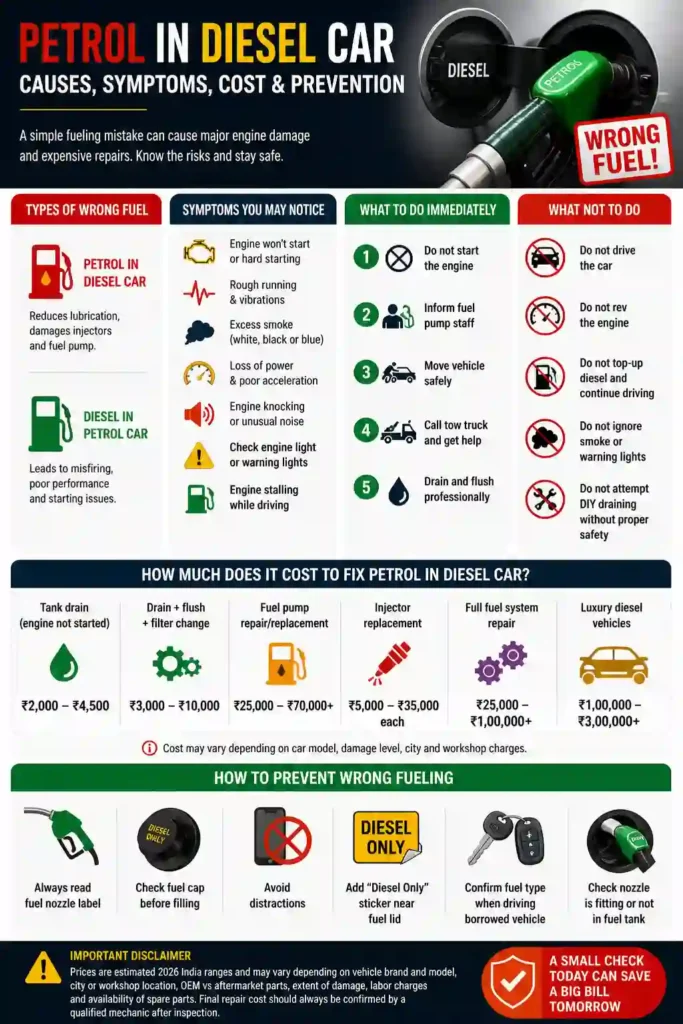
Symptoms of Petrol in Diesel Car
If misfuelling is not noticed immediately after refueling, the vehicle may begin showing several warning signs. These symptoms often appear once the contaminated fuel starts moving through the engine and fuel system. Watch for these common signs after refueling:
1. Loss of Power
The car may feel weak during acceleration and may not respond normally when pressing the throttle.
2. Rough Engine Idle
The engine may vibrate, shake, or show unstable RPM while the vehicle is stationary.
3. White or Grey Smoke
Unburned fuel may come out through the exhaust, creating noticeable white or grey smoke.
4. Knocking Noise
You may hear ticking, rattling, or metallic knocking sounds from the engine.
5. Engine Stalling
The vehicle may suddenly shut off while idling or driving.
6. Check Engine Light
Warning lights may appear on the dashboard as the engine management system detects a problem. If these symptoms appear after refueling, petrol in a diesel car could be the cause, and the vehicle should be stopped immediately to avoid further damage.
How Much Petrol Is Harmful in a Diesel Car?
Many drivers believe that even a small amount of petrol in a diesel car will immediately destroy the engine. In reality, the result depends on several factors such as how much petrol was added, how much diesel was already in the tank, whether the engine was started, and how far the vehicle was driven.
An older workshop experiment showed that one diesel vehicle was still able to run temporarily with a petrol-diesel mixture when a significant amount of diesel remained in the tank. However, this should be treated as a single case study, not a rule for all vehicles. Modern common-rail diesel engines are often more sensitive than older diesel systems.
From an engineering point of view, petrol can still reduce lubrication, affect injector performance, and change combustion behavior. That means a car may appear normal at first, but internal wear or delayed problems can still occur.
| Petrol Amount | Risk Level | What May Happen |
|---|---|---|
| Few drops | Low | Usually no immediate issue if tank is mostly diesel, but topping up with diesel is still wise. |
| 1–2 litres | Moderate | Car may still start and run normally, though lubrication quality begins to reduce. |
| Around 20L added to a mostly diesel tank | Medium | Some engines may continue running temporarily, as seen in the older workshop test. |
| Roughly 50/50 mix | High | Engine may still run in some cases, but risk to fuel pump and injectors rises significantly. |
| Mostly petrol / full tank petrol | Severe | Hard starting, stalling, poor combustion, and major fuel system damage risk become much higher. |
Why Some Cars Still Start
A diesel car may still start after petrol in a diesel car because:
- Diesel is still present in the tank
- Diesel remains in fuel lines
- Residual diesel helps initial combustion
- Damage may not happen instantly
This can create the false impression that everything is fine.
Repair Cost in India (2026)
The repair cost of petrol in a diesel car mainly depends on one important factor, whether the engine was not started, only started, or driven for some distance. If the mistake is caught early, the cost is usually limited to draining and cleaning the fuel system. If the vehicle is driven, expensive parts such as the fuel pump and injectors may need repair or replacement.
| Situation | Approximate Cost (India) | What Usually Happens |
|---|---|---|
| Tank drain only | ₹2,000 – ₹4,500 | Fuel removed before engine start. Best-case scenario. |
| Flush + fuel filter change | ₹3,000 – ₹10,000 | Fuel lines cleaned and filter replaced after mild contamination. |
| Fuel pump repair / replacement | ₹25,000 – ₹70,000+ | Petrol reduces lubrication and may damage the high-pressure pump. |
| Injector replacement | ₹5,000 – ₹35,000 each | One or more injectors may clog, wear, or fail. |
| Full fuel system repair | ₹25,000 – ₹1 lakh+ | Pump, injectors, lines, filters, sensors may need major work. |
| Premium / luxury diesel cars | ₹1 lakh – ₹3 lakh+ | Luxury brands often have costly injectors and advanced fuel systems. |
Cost Based on Damage Level
1. If Engine Was NOT Started
- This is the cheapest and safest case.
- Petrol usually remains inside the tank.
- Common repair work:
- Drain fuel tank
- Flush fuel lines
- Refill clean diesel
- Expected Cost: ₹2,000 – ₹8,000
2. If Engine Was Started but Car Not Driven
- Petrol begins circulating through the system.
- Some workshops may recommend filter replacement and system cleaning.
- Expected Cost: ₹5,000 – ₹15,000
3. If Car Was Driven for a Short Distance
- Fuel pump and injectors begin facing lubrication loss.
- Car may show smoke, rough idle, or power loss.
- Expected Cost: ₹15,000 – ₹60,000+
4. If Car Was Driven for Long Distance
- High-pressure pump damage becomes more likely.
- Injectors may require replacement.
- Full cleaning of rails and lines may be needed.
- Expected Cost: ₹50,000 – ₹1 lakh+
5. Luxury Diesel Cars
Vehicles such as premium German SUVs or luxury sedans may cost significantly more because parts are expensive and labor is specialized.
- Expected Cost: ₹1 lakh – ₹3 lakh+
Important Disclaimer
The prices mentioned above are estimated 2026 repair cost ranges for India and should be used only as a general reference. Actual costs may vary depending on the vehicle brand and model, city or workshop location, whether OEM or aftermarket parts are used, the extent of damage caused, local labor charges, and the availability of spare parts. Since every misfuelling case can be different, the final repair cost should always be confirmed by a qualified mechanic after a proper inspection.
Why Repair Cost Can Rise Quickly
Modern common-rail diesel engines use:
- Precision injectors
- High-pressure fuel pumps
- Electronic sensors
- Tight tolerances
Even small internal damage can lead to expensive replacement bills.
What To Do Immediately
If you realize there is petrol in a diesel car, acting quickly can prevent expensive damage. The most important thing is to stop the contaminated fuel from circulating through the engine and fuel system.
Step 1: Do Not Start the Engine
- If you notice the mistake before turning the key or pressing the start button, keep the car switched off. Starting the engine can send petrol through the fuel pump, injectors, and fuel lines.
Step 2: Inform Fuel Pump Staff
- Let the fuel station staff know that the wrong fuel was added. They may help you move the vehicle safely and guide you on the next steps.
Step 3: Move Vehicle Safely
- If the car is blocking the pump area, move it manually by pushing it to a safe location if possible. Do not start the engine just to reposition it.
Step 4: Call a Tow Truck
- Arrange towing and take the vehicle to a trusted garage or service center. This is much safer than trying to drive with petrol in a diesel car.
Step 5: Drain and Flush Professionally
Have the fuel tank drained and the system cleaned by a professional mechanic. In many cases, this is the safest and cheapest solution when handled early.
What NOT To Do
If there is petrol in a diesel car, the wrong actions can increase damage quickly. Many drivers panic and try temporary fixes, but that often makes the situation worse.
1. Do Not Drive the Car
- Driving the vehicle allows contaminated fuel to move further through the system, increasing the risk of damage to the fuel pump and injectors.
2. Do Not Top-Up Diesel and Continue Driving
- Adding diesel may dilute the petrol, but it does not guarantee safety. The wrong fuel mixture can still cause problems.
3. Do Not Ignore Smoke or Warning Lights
- White smoke, rough running, loss of power, or dashboard warnings are signs that the engine is not happy. Continuing to drive may lead to higher repair costs.
4. Do Not Attempt DIY Draining Without Proper Safety
- Fuel is highly flammable, and draining a tank without proper tools or safety precautions can be dangerous. Professional help is the safer option.
How To Prevent Wrong Fueling
Preventing petrol in a diesel car is always easier and cheaper than dealing with repairs later. A few simple habits at the fuel station can help you avoid an expensive mistake.
1. Always Read the Fuel Nozzle Label
- Before fueling, take a moment to read the pump label carefully. Never assume the correct nozzle is already selected.
2. Check the Fuel Cap Before Filling
- Most vehicles clearly mention the correct fuel type on the fuel cap or near the filler neck. Always confirm before inserting the nozzle.
3. Check Whether the Nozzle Fits Properly
- Do not rely only on nozzle fit. In many cases, a petrol nozzle is smaller and can still fit into a diesel tank. If the nozzle feels unusual or you are unsure, stop and double-check the fuel type.
4. Avoid Distractions
- Phone calls, conversations, or rushing can lead to simple mistakes. Stay focused while refueling.
5. Add a “Diesel Only” Sticker Near the Fuel Lid
- A visible reminder near the fuel lid can help both you and fuel station staff avoid confusion.
6. Confirm Fuel Type in a Borrowed or New Vehicle
- If you are driving a borrowed, rented, or newly purchased vehicle, confirm whether it uses petrol or diesel before visiting the fuel station.
7. Recheck Before Paying
- Before the fueling is completed, quickly verify the selected fuel type on the pump display. Catching a mistake early can save a lot of money.
Conclusion
Putting petrol in a diesel car does not always mean the engine will fail instantly, but it is still a mistake that should never be ignored. In some cases, the vehicle may continue running for a short time, especially if enough diesel is already present in the tank. However, that does not mean everything is safe inside the fuel system.
Petrol lacks the lubrication that diesel components depend on, and continued driving can increase the risk of damage to the fuel pump, injectors, and other expensive parts. The longer the contaminated fuel circulates, the higher the chance of costly repairs.
If the mistake is caught before starting the engine, the solution is often simple and much cheaper. But if the car is driven, a small fueling error can quickly become a major workshop bill.
The smartest approach is simple: stop immediately, avoid starting the engine, and get professional help. In the end, a few seconds of checking the fuel nozzle at the pump is far easier than paying thousands later for petrol in a diesel car repairs.
How long will a diesel car drive with petrol in it?
There is no fixed answer because it depends on how much petrol was added, how much diesel was already in the tank, the engine type, and driving conditions. Some diesel cars may continue running for a short distance if enough diesel is still mixed in the tank, while others may begin showing symptoms quickly such as rough running, smoke, loss of power, or stalling. Even if the car still drives, it is not recommended to continue using it with petrol in a diesel car.
Is it okay to put petrol in a diesel car?
No, it is not okay to put petrol in a diesel car. Diesel engines are designed to run on diesel fuel, which also helps lubricate important fuel system parts. Petrol burns differently and has much lower lubricating ability. Using the wrong fuel can lead to poor performance, increased wear, and expensive damage if the vehicle is driven.
Will 3 litres of petrol damage a diesel engine?
Three litres of petrol may or may not cause immediate damage depending on tank size and how much diesel is already present. In a nearly full diesel tank, the petrol becomes diluted and the risk may be lower. In a nearly empty tank, the petrol concentration is higher, which increases risk. Modern common-rail diesel engines are more sensitive, so even small amounts should be taken seriously. The safest option is still to drain or professionally inspect the vehicle.
How to fix petrol in a diesel car?
The safest way to fix petrol in a diesel car is to stop using the vehicle and have it professionally repaired. In most cases, the process includes:
1. Do not start the engine (if not already started)
2. Switch off immediately if already running
3. Tow the vehicle to a workshop
4. Drain the fuel tank
5. Flush fuel lines
6. Replace the fuel filter if required
7. Refill with clean diesel
8. Inspect pump and injectors if the car was driven
Quick action usually reduces repair cost and damage risk.
How much does it cost to fix petrol in a diesel car?
The cost to fix petrol in a diesel car depends on whether the engine was started, how far the vehicle was driven, and the extent of damage caused. If the mistake is noticed early before starting the engine, the repair is usually limited to draining the fuel tank and flushing the system, which may cost around₹2,000 to ₹10,000.
If the car was started or driven, petrol may affect the fuel pump, injectors, and other components, which can increase the repair bill significantly. In such cases, costs may range from ₹25,000 to ₹1 lakh or more, especially for modern common-rail diesel cars. Luxury diesel vehicles can cost even higher depending on parts and labor charges.
The final repair cost may vary based on the vehicle model, city, workshop rates, and level of damage, so a proper inspection by a qualified mechanic is always recommended.

Kashi Vishwanath is a Mechanical Engineering graduate and the founder of Kautoverse. He writes about cars, bikes, engines, and automotive technology, with a focus on simplifying technical concepts and helping readers make informed automotive decisions through detailed guides, reviews, and comparisons.