

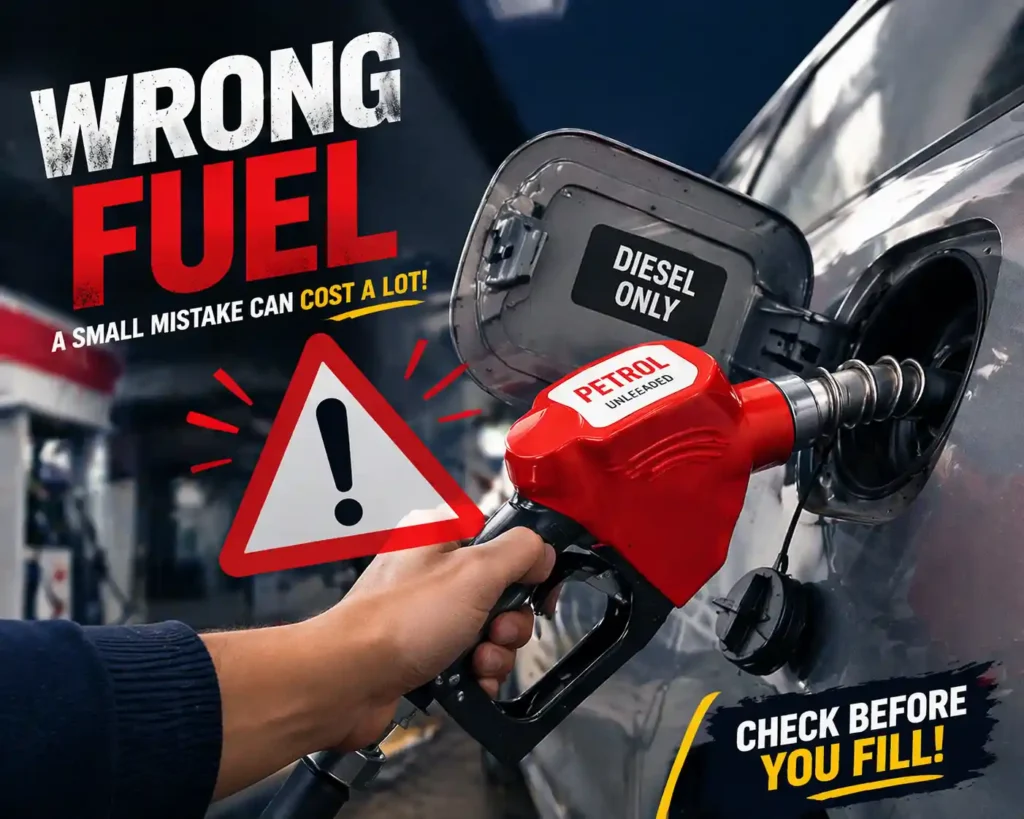
Wrong fuel is one of the costly mistake made many people in a year same way recently my friend Ganesh had just returned from a long drive in the evening. He was exhausted, but he had to go to the office early the next morning. So, to avoid any delay, he decided to refuel his car the same night. Like always, he went to his regular petrol bunk and the same place many times before. Every time, everything had gone perfectly. But that day… something went wrong. The worker at the fuel station accidentally filled the wrong fuel.
Ganesh didn’t realize it. Everything seemed completely normal. He started the car and went. For the first 2 minutes all went well, then the real problem started. Suddenly the engine began to shake, power dropped instantly & strange knocking sounds appeared. Within moments, the car started failing, and Ganesh had no idea what was happening.
If you ever face the same situation, this blog will help you avoid serious engine damage and save thousands of rupees.
Putting the wrong fuel in car is also called misfuelling is more common than most people think. Thousands of drivers make this mistake every year, often due to distraction or many reasons. But what actually happens inside your engine? And more importantly, that can be fix it before leads to big damage.
Causes of Wrong Fuel in Vehicles
There are multiple reasons for occuring wrong fuel in vehicles. their are
1) Distraction at the Fuel Station
- Most of drivers are distracted by phone calls, or conversation with people are busy in doing payments. This disctration leads to misfuelling.
2) Fuel Attendant Error
- In our country like the India their is fuel attendant to refuel the vehicle. So, sometimes attendant assumes wrong fuel or busy in fuel station because of rush.
3) Poor Labeling or Lack of Clear Communicaton
- Sometimes their no clear marking on fuel or petrol or diesel Stickers used on fuel tank fade over time or even with no clear communication with attendant can also leads to wrong fueling.
4) Similar Nozzle Design (Design Limitation)
- Generally the diesel nozzle is larger than petrol nozzle but in some regions they not follow these rules are strict. so, Petrol nozzle can still fit into diesel cars.
Before that, you need to know what the key differences are between petrol and diesel engines, and then you will understand better what is happening when misfuelling occurs.
Key Difference between petrol and diesel engines
The basic difference between petrol and diesel engines are petrol engines work on spark plugs to ignite a air-fuel mixture, while diesel engines use high compression and depend on diesel fuel not only for combustion but also for lubrication of critical components like the fuel pump and injectors. Because of these differences, using the wrong fuel disrupts both combustion and mechanical functioning.
Types of wrong fueling
There are many types of misfueling; these can affect your car very deeply, such that you lose a lot of money from your pocket. The misfueling can be the following types, & they are
- Petrol is in a diesel car
- Diesel in a Petrol Car
- Incorrect Octane Rating
- AdBlue in Diesel Fuel Tank
1. Petrol is in a diesel car
When petrol is filled into a diesel engine accidentally, it creates a big problem for the vehicle because of its fundamental differences in fuel properties like viscosity. and the working process of the engine. The diesel engines work based on compression ignition, where fuel is injected into highly compressed air and ignites due to high temperature.
Diesel fuel has a specialty that is lubrication properties and a higher flash point, which are essential for protecting sensitive components like the fuel pump and injectors. While coming to petrol is more volatile, thinner, and has no lubrication properties. This leads to when petrol enters a diesel engine, it not only disturbs the combustion process but also removes the lubrication needed for fuel system components, leading to rapid wear and tear and potential failure.
Another important practical factor is nozzle design. In most cases, a petrol nozzle is smaller in diameter, so it can easily fit into a diesel car’s filler neck, making this type of misfueling more common. Unlike the reverse case, there is usually no physical prevention, which increases the risk of accidental filling. Misfueling often happens due to:
- Driver distraction or habit
- Similar-looking fuel pumps
- Rushing at fuel stations
- Human error by fuel attendants
This case is significantly more destructive because:
- Petrol has no lubricating properties this causing metal-to-metal contact
- Diesel fuel system components (pump & injectors) depend on fuel for lubrication
- Petrol lowers the flash point which causing improper or premature combustion
- High-pressure systems (common rail) are extremely sensitive to fuel quality
2. Diesel in a Petrol car
When diesel fuel is accidentally filled into a petrol engine, the problem mainly arises because of fundamental differences in combustion and fuel properties. Petrol engines rely on spark ignition, where a spark plug ignites a highly volatile fuel-air mixture. Diesel, on the other hand, is less volatile, heavier, and designed for compression ignition and it does not vaporize or ignite easily under spark conditions. As a result, when diesel enters a petrol engine, it fails to burn properly, leading to misfires, incomplete combustion, rough running, and often the engine refusing to start.
Another important practical factor is nozzle design. In most cases, a diesel nozzle is larger in diameter, so it typically does not fit into a petrol car’s filler neck, which acts as a natural prevention system. However, misfueling can still happen through:
- Using containers (manual filling)
- Modified or worn filler necks
- Fuel station mistakes
Compared to petrol in diesel engines, this case is generally less destructive because:
- Diesel still provides some lubrication (unlike petrol)
- No high-pressure diesel pump damage occurs
- Main issues are combustion-related, not mechanical wear
However, if ignored, it can still lead to:
- Injector clogging
- Catalyst damage
- Reduced engine efficiency over time
3. Incorrect Octane Rating
Using petrol with an incorrect octane rating in a petrol engine can affect performance and, in some cases, lead to engine damage. Octane rating indicates a fuel’s ability to resist knocking (pre-ignition). Higher-octane fuel burns more smoothly under pressure, while lower-octane fuel can ignite prematurely.
Petrol engines are designed to operate with a specific minimum octane requirement (for example, 91, 95, or higher). When fuel with a lower octane than recommended is used, it may ignite before the spark plug fires, causing engine knocking, reduced efficiency, and increased mechanical stress.
This case is leads to
- Premature combustion (knocking): Fuel ignites too early due to high pressure and temperature
- Irregular flame propagation: Leads to uneven power delivery
- Increased heat and pressure spikes: Can damage internal components over time
4. AdBlue in Diesel Fuel Tank
What is AdBlue?
AdBlue is a non-toxic, water-based solution made of 32.5% high-purity urea and 67.5% deionized water, used in diesel vehicles equipped with Selective Catalytic Reduction (SCR) systems to reduce harmful exhaust emissions.
It is not a fuel or fuel additive. Instead, AdBlue is stored in a separate tank and injected into the exhaust system, where it reacts with nitrogen oxides (NOx) and converts them into harmless nitrogen (N₂) and water vapor (H₂O).
When AdBlue (Diesel Exhaust Fluid) is mistakenly filled into the diesel fuel tank, it creates a serious contamination issue because AdBlue is not a fuel. Diesel engines require pure hydrocarbon fuel with lubricating properties, while AdBlue contains water and chemicals that are completely incompatible with the fuel system.
Once AdBlue enters the diesel tank, it does not mix properly with diesel and instead causes chemical reactions and crystallization. The water content leads to corrosion, while urea forms solid crystals that can block fuel lines, injectors, and pumps.
Another practical factor is cap design and labeling. Most vehicles have:
- A blue cap for AdBlue
- A black/yellow cap for diesel
Despite this, mistakes happen due to:
- Confusion between caps
- Refilling from containers
- Lack of attention during maintenance
What Happens Inside the System
- Crystallization: Urea forms hard deposits that clog injectors and lines
- Corrosion: Water content damages metal components
- Fuel contamination: Diesel loses its combustion properties
- Pump failure: Lack of proper fuel lubrication and contamination
If Ignored, It Can Lead To:
- Complete fuel system blockage
- Injector and pump failure
- Rust and corrosion inside tank and lines
- Engine no-start condition
- Very high repair costs (often full system replacement)
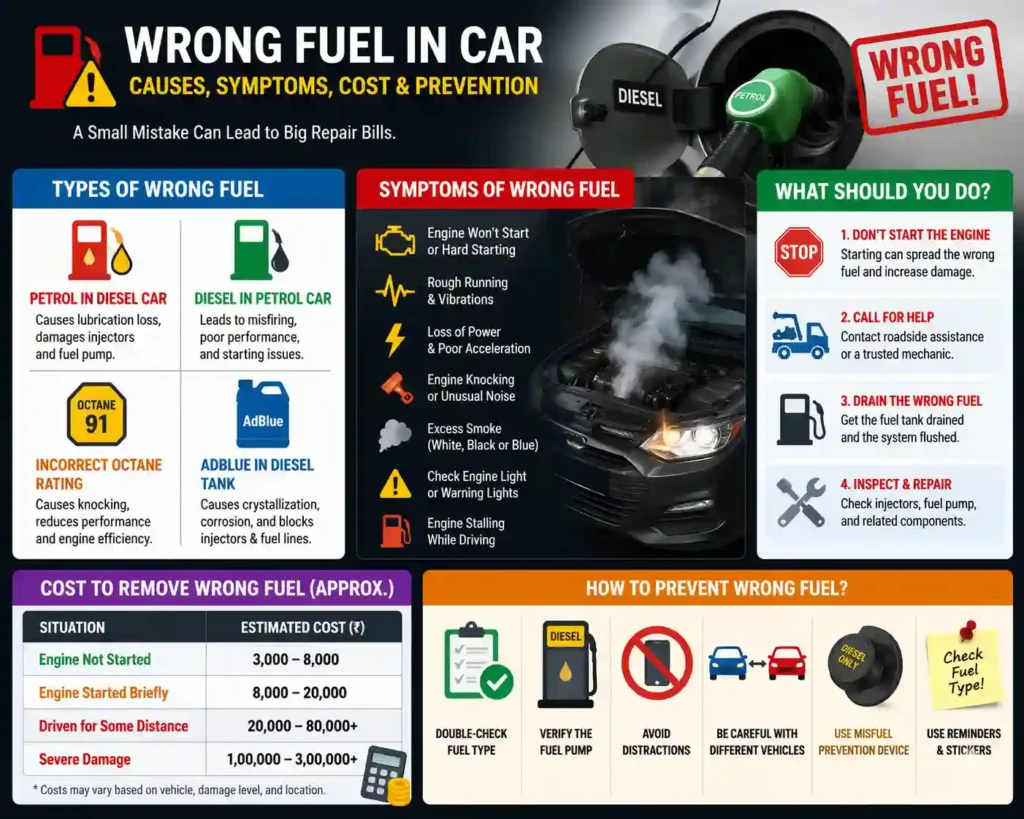
Symptoms of Wrong Fuel in a Vehicle
Wrong fuel (misfueling) shows clear and progressive symptoms, often appearing within minutes after refueling. The exact signs depend on whether it’s petrol in diesel or diesel in petrol, but many symptoms overlap.
1) Engine won’t start / hard starting
When you try to start engine but doesn’t start, it is a common symptom in the diesel-in-petrol case. This happens because diesel fuel is less volatile and does not vaporize easily, which is essential for spark ignition in petrol engines. As a result, the spark plug cannot ignite the air-fuel mixture properly, leading to no combustion despite the engine turning over. The engine may keep cranking, but it fails to fire due to the incorrect fuel characteristics and poor ignition ability.
2) Engine vibration at low speed
The engine runs unevenly due to improper combustion caused by wrong fuel because the air-fuel mixture does not burn correctly, leading to engine vibrations and unstable operation. As a result, the RPM fluctuates irregularly, making the engine feel shaky or jerky
3) Engine knocking
The wrong fuel is also leading engine knocking sound that occurs due to improper combustion timing inside the engine. When the fuel ignites too early or unevenly, it creates sudden pressure spikes, leading to this noise. This issue is commonly seen in petrol-in-diesel cases, where incorrect fuel properties disrupt normal combustion.
4) Engine Smoke Indicates Wrong Fuel
Unusual exhaust smoke is a key symptom of wrong fuel and can vary in color depending on the issue. White or grey smoke typically indicates incomplete combustion, commonly seen in petrol-in-diesel cases where fuel does not burn properly under compression. Black smoke suggests excess unburnt fuel, often occurring in diesel-in-petrol situations due to poor ignition of heavier fuel. In more severe cases, blue smoke may appear, indicating oil or fuel mixing problems caused by improper combustion, often accompanied by a burning smell.
5) Warning Lights & Indicators
When wrong fuel is used, modern vehicles quickly detect abnormal combustion and fuel system issues through sensors, triggering various dashboard warning lights and indicators. The most common is the check engine light (CEL), which appears due to misfire, improper combustion, or abnormal fuel pressure. In some cases, the light may flash, indicating a severe misfire. Vehicles may also show a fuel system or injection warning, especially when components like injectors or the fuel pump are affected.
Additionally, the car can enter limp mode, reducing power and limiting speed to prevent further damage. Other signs include emission warnings, unusual engine behavior alerts, and irregular fuel readings. These indicators act as early warnings, and ignoring them after refueling can lead to serious engine damage.
Cost of Wrong Fuel in vehicle
The cost of wrong fuel depends mainly on one major factor that is whether the engine started or not? and also supports other factors like type of engine (petrol vs diesel), duration of driving and extent of fuel system contamination
Case 1: Wrong Fuel but Engine not started
- Only fuel tank contamination
- No circulation in system
Typical Cost (India):
- Fuel draining & flushing: ₹5,000 – ₹10,000
- Fuel filter replacement: ₹1,000 – ₹3,000
Total: ₹6,000 – ₹13,000
Case 2: Engine Started not for long time (within few minutes or seconds)
- Fuel reaches injectors and pump
- Minor wear begins
Typical Cost:
- Tank drain + line flushing: ₹8,000 – ₹15,000
- Filter + cleaning: ₹2,000 – ₹5,000
- Engine oil change (if needed): ₹2,000 – ₹4,000
Total: ₹10,000 – ₹15,000
Case 3: Driven for Some Distance
- Full system contamination
- Injectors and pump affected
Typical Cost:
- Injector cleaning/replacement: ₹5,000 – ₹25,000+
- Fuel pump repair/replacement: ₹10,000 – ₹40,000
- Complete system flush: ₹5,000 – ₹15,000
Total: ₹25,000 – ₹80,000+
Case 4: Severe Damage (Long Driving / Ignored)
- Major component failure
- Possible engine damage
Typical Cost:
- Full fuel system replacement: ₹50,000 – ₹1,50,000+
- Engine repair (if damaged): ₹50,000 – ₹2,00,000+
Total: ₹1 lakh – ₹3 lakh+
NOTE
The cost figures mentioned are approximate and may vary based on vehicle type, location, labor charges, and damage severity. Always consult a professional for accurate estimates.
How to Prevent Wrong Fuel
Taking simple precautions can effectively prevent the costly mistake of misfuelling. Since most cases occur due to distraction or habit, being attentive and following basic checks can save significant repair costs and engine damage.
1) Always double-check fuel type
Before filling, confirm whether your vehicle uses petrol or diesel. Check the fuel cap label, dashboard reminder, or owner’s manual to avoid confusion, especially when driving a new or borrowed vehicle.
2) Verify the fuel pump
Do not rely only on color codes. Always read the label on the fuel dispenser before inserting the nozzle. This reduces the risk of picking the wrong fuel in busy or poorly lit stations.
3) Stay focused while refueling
Avoid distractions like phone calls or conversations. Many misfueling incidents happen due to lack of attention or routine habits.
4) Be careful with different vehicles
If you frequently switch between petrol and diesel vehicles, take an extra moment to confirm the correct fuel type before filling.
5) Use misfuel prevention devices
Install devices like fuel cap locks or misfuel guards that physically prevent inserting the wrong nozzle, especially useful for diesel cars.
6) Keep a stickers near fuel cap
You can place a sticker near the fuel cap or dashboard indicating the correct fuel type for quick reference.
7) Do not start if unsure
If you suspect wrong fuel has been added, do not start the engine. Immediate action can prevent major damage.
Conclusion
Wrong fuel in a car (misfueling) is a common mistake that can lead to serious issues if not handled properly. As explained, different cases such as petrol in diesel, diesel in petrol, incorrect octane rating, and AdBlue contamination affect the engine in different ways. These problems often show early symptoms like starting issues, rough engine performance, knocking sounds, unusual smoke, and warning lights, which should never be ignored.
The cost of repair can vary widely—from simple fuel draining to expensive replacement of components like injectors and fuel pumps—depending on how quickly the issue is identified and addressed. The key takeaway is that starting or driving the vehicle increases damage significantly, while early action can keep costs low.
By following simple precautions such as double-checking fuel type, verifying the pump, and staying attentive while refueling, misfueling can be easily avoided.
FAQ’s
What happens if you put wrong fuel?
Putting the wrong fuel in a car disrupts the combustion process, causing the engine to run poorly or not start at all. It can lead to symptoms like misfiring, loss of power, knocking, and smoke, and if the engine is run, it may damage components like injectors and fuel pumps. The severity depends on the fuel type and how quickly the issue is addressed.
What are the symptoms of wrong fuel?
1. Engine won’t start or hard starting
2. Rough running or engine vibration
3. Sudden loss of power
4. Engine knocking or unusual noise
5. Excess smoke (white, black, or blue)
6. Check engine light or warning lights
7. Poor acceleration and jerking
How much to remove wrong fuel?
Engine not started: ₹5,000 – ₹8,000 (fuel draining & flushing)
Engine started briefly: ₹8,000 – ₹20,000
If driven (system contamination): ₹20,000 – ₹80,000+
Cost depends on damage level and how quickly you act.
Is petrol in diesel worse than diesel in petrol?
Yes, petrol in diesel is more dangerous because it removes lubrication and damages components.
Does insurance cover wrong fuel?
Usually, no. Misfueling is considered driver error, but roadside assistance may help.

Kashi Vishwanath is a Mechanical Engineering graduate and the founder of Kautoverse. He writes about cars, bikes, engines, and automotive technology, with a focus on simplifying technical concepts and helping readers make informed automotive decisions through detailed guides, reviews, and comparisons.